1 / 7
0:00/0:00
Solo
2024
cello
- Program Notes
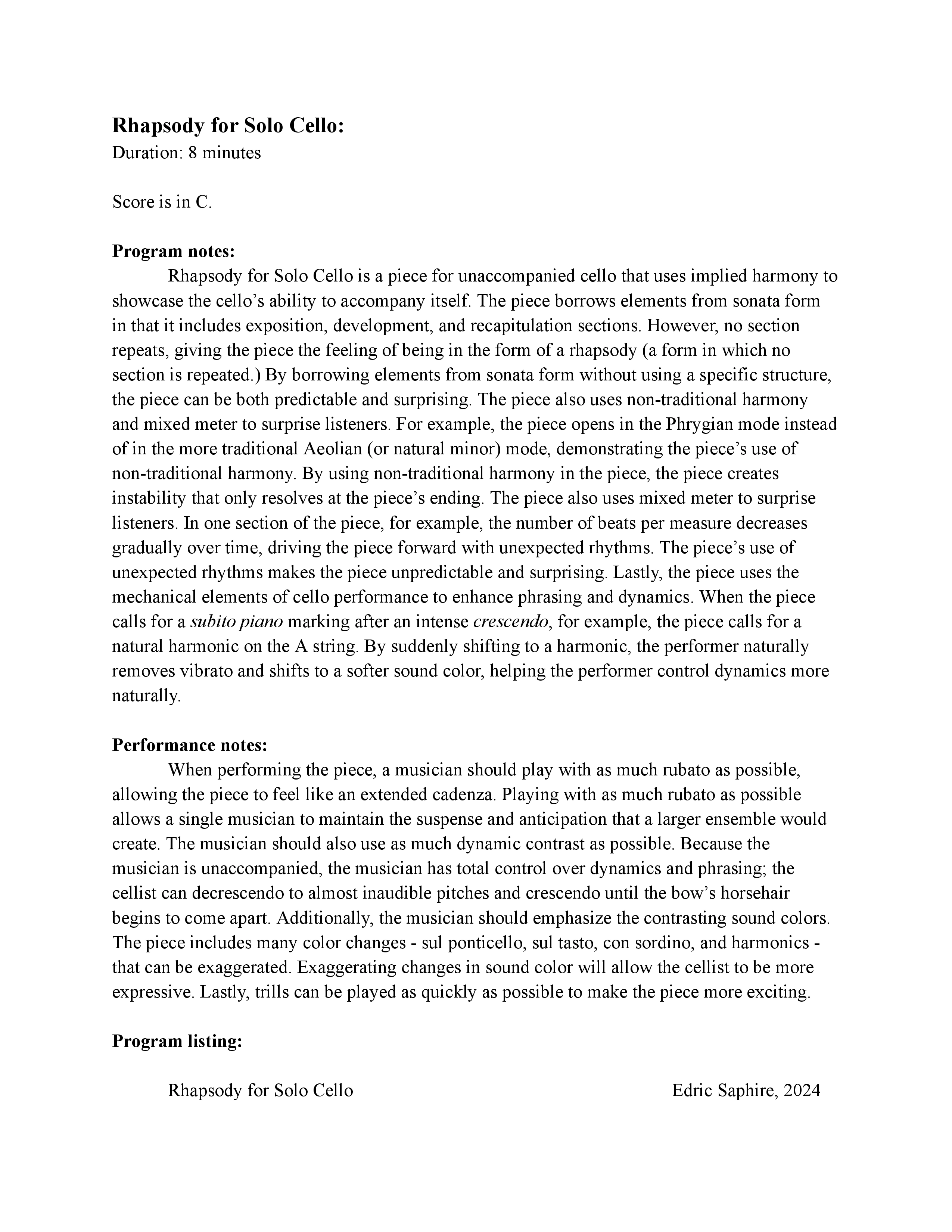
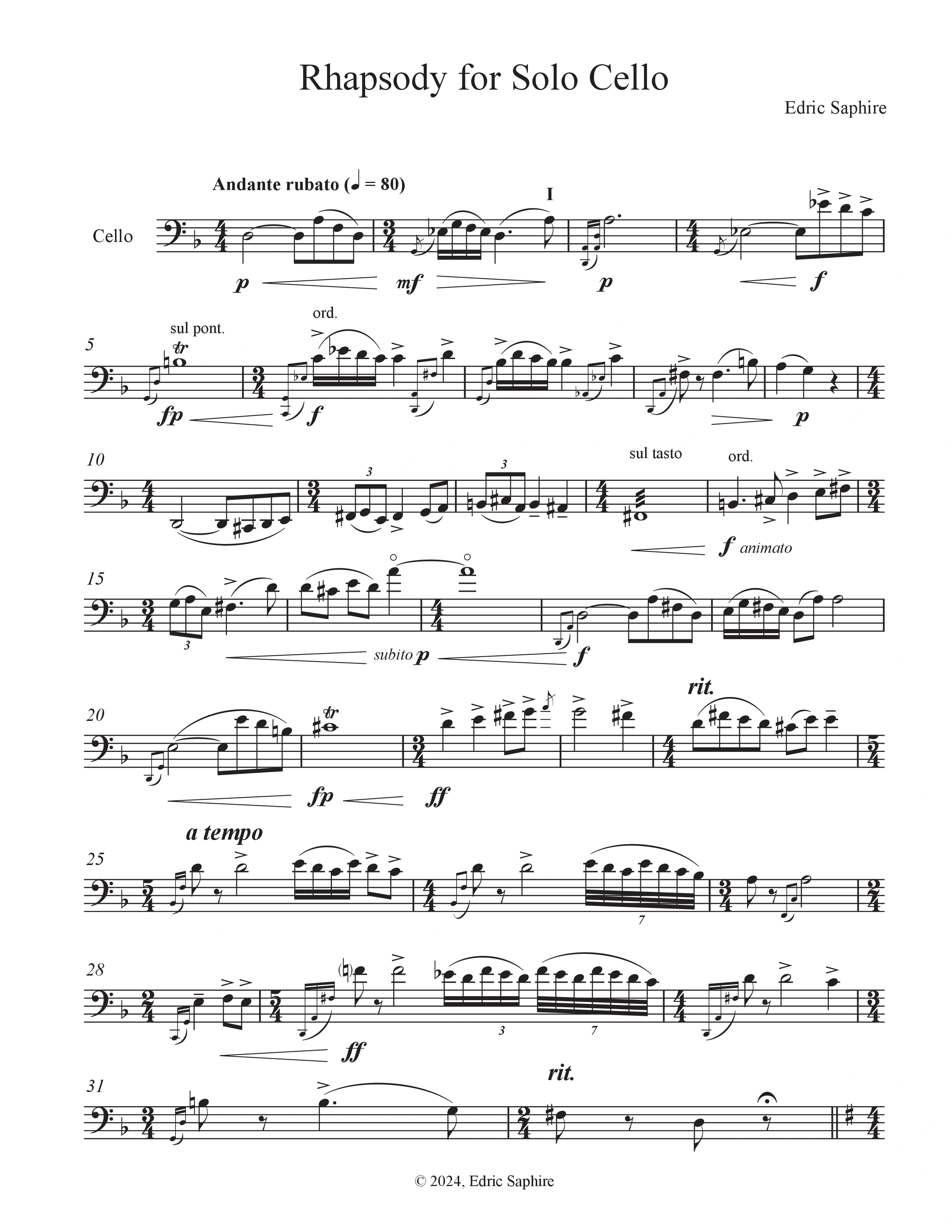
- Rhapsody for Solo Cello is a piece for unaccompanied cello that uses implied harmony to showcase the cello’s ability to accompany itself. The piece borrows elements from sonata form in that it includes exposition, development, and recapitulation sections. However, no section repeats, giving the piece the feeling of being in the form of a rhapsody (a form in which no section is repeated.) By borrowing elements from sonata form without using a specific structure, the piece can be both predictable and surprising. The piece also uses non-traditional harmony and mixed meter to surprise listeners. For example, the piece opens in the Phrygian mode instead of in the more traditional Aeolian (or natural minor) mode, demonstrating the piece’s use of non-traditional harmony. By using non-traditional harmony in the piece, the piece creates instability that only resolves at the piece’s ending. The piece also uses mixed meter to surprise listeners. In one section of the piece, for example, the number of beats per measure decreases gradually over time, driving the piece forward with unexpected rhythms. The piece’s use of unexpected rhythms makes the piece unpredictable and surprising. Lastly, the piece uses the mechanical elements of cello performance to enhance phrasing and dynamics. When the piece calls for a subito piano marking after an intense crescendo, for example, the piece calls for a natural harmonic on the A string. By suddenly shifting to a harmonic, the performer naturally removes vibrato and shifts to a softer sound color, helping the performer control dynamics more naturally.
- Recording Notes
Recorded by Monday Music by Jacky Hannan Du with the Massachusetts Music Creator's Forum.
- Performer Credits
- Ethan Murphy - Massachusetts Music Creator's Forum/New England Conservatory
- Publisher
- Edric Saphire