1 / 69
0:00/0:00
Quartet
2024
Clarinet
Drum Set
Otamatone
Piano
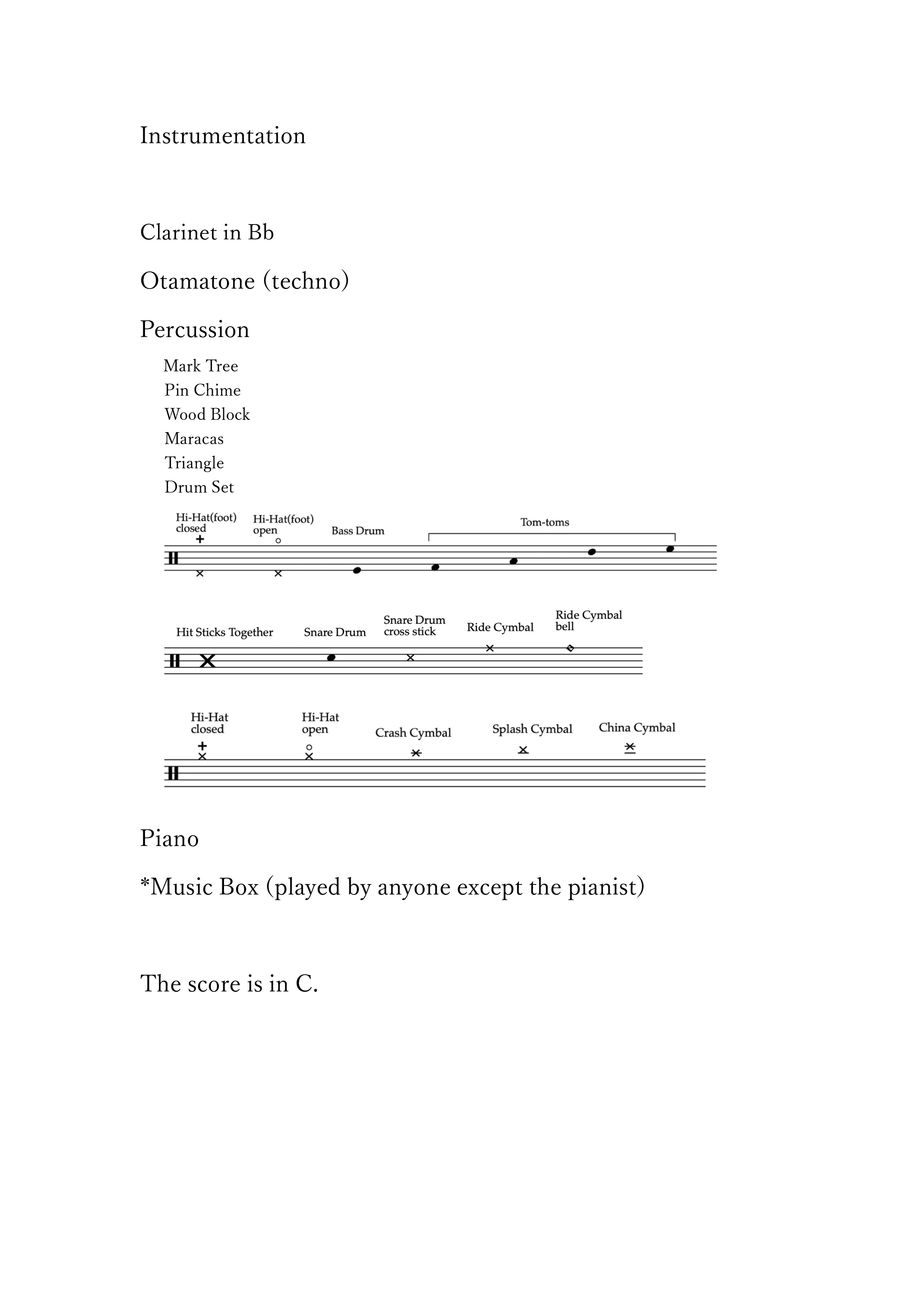
Unpitched Percussion
Music Box
- Program Notes
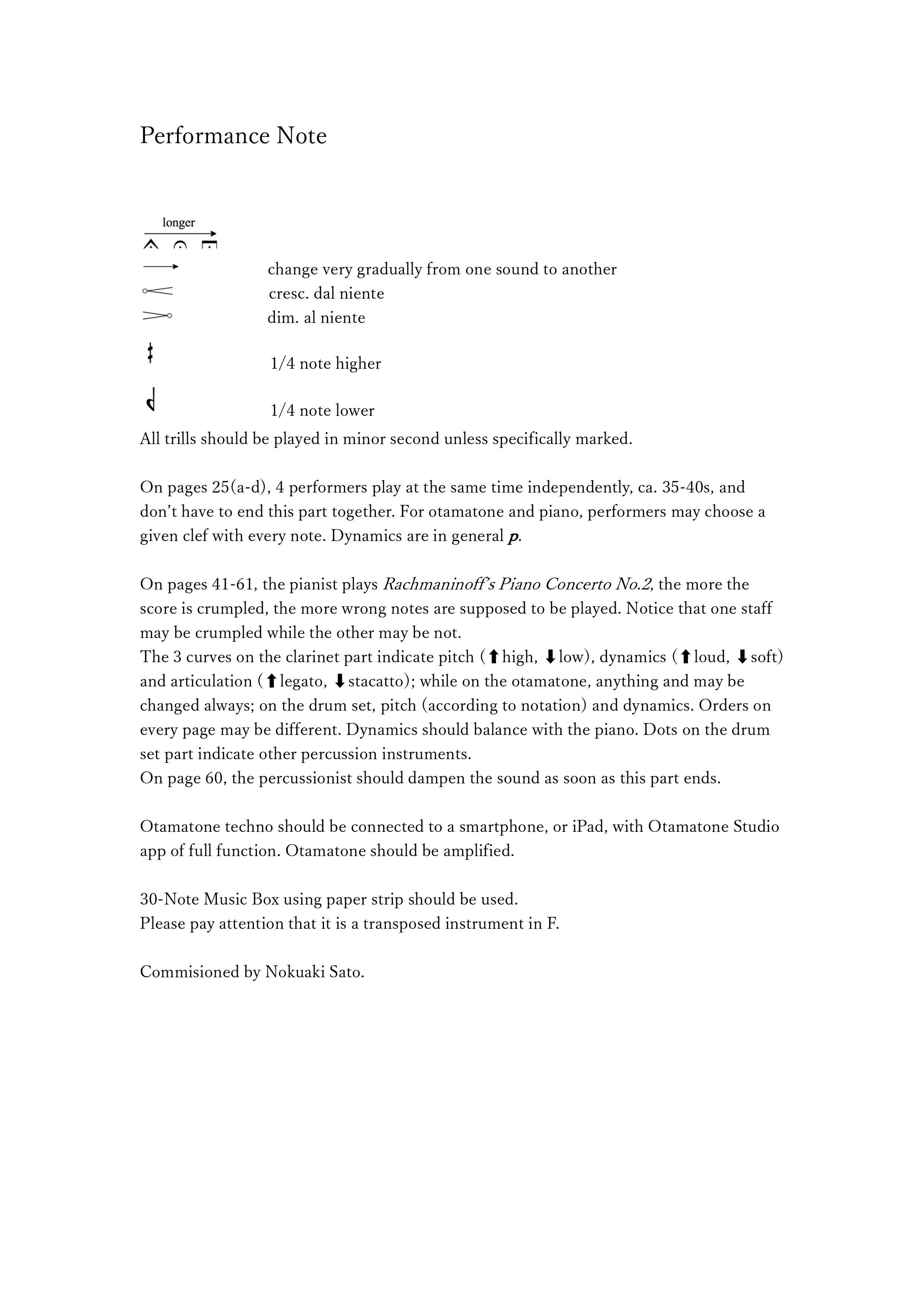
My Piano Sonata No. 1 was something I intended to write before falling in love, and I composed it after that and dedicated it to her. I will premiere it at my piano recital on February 18, 2025. We broke up this year. Shortly after, Nobuaki Satoh commissioned me to write a piece for drum set and some other instruments. Initially, I thought of Piano Sonata No. 2 for piano and an optional drum set. However, I wanted to add a clarinet (which I consider "crazy") and an Otamatone (which I describe as "absurd"). Then, it was no longer a "Piano Sonata," so it became Although I intended to write Piano Sonata No. 2. The overall structure consists of an exposition, three development sections, and a coda. The exposition starts with a piano solo. The score looks difficult because of various unusual tuplets, but they are not mathematically calculated. Instead, I intuitively wrote the note lengths and the speed of a sequence of notes. Like Bach’s "notated ornaments", I called this "notated improvisation." The pitches were chosen intuitively, blending tonality and atonality. The first development section transitions into a 3/8 meter at a dotted eighth note = 72, a tempo I had used in several past works. It incorporates material from Piano Sonata No. 1 and I developd the motif of repeated notes. Then there are bouquet-shaped graphic scores. The second development section uses pop chord progressions, 4-5-3-6-2-5-1, and its variations. This section is particularly beautiful, featuring irregular meter while maintaining a consistent time signature—a technique often used in Kapustin’s works. The third development section includes a quote from Rachmaninoff's Piano Concerto No. 2 in the piano part, improvisations based on curves in the other parts, and a crazy climax. The coda is a "music box" section. While composing this piece, my grandmother became ill and passed away. After that, on my way home, the initial four measures came to me. "Absurd, meaningless, sweet, and extremely difficult"—those were the words I wrote after completing the piece. Through this work, I discovered neo-Romanticism in my music.
- Performer Credits
- Clarinet, Rio Ishida/石田理雄 Otamatone, Music Box, Yikun Qi/斉芸琨 Percussion, Yujin Honda/本多悠人 Piano, Yui Amano/天野由唯 Conduct, Koga Yano/矢野耕我
- External Links