
1 / 10
0:00/0:00
Solo
2011
Flute
- Program Notes
What I explored in this work might be described as the “musicality” or “breathing” of machines.
When we hear the word “machine,” we may first imagine a kind of literally “mechanical” behavior: the calm, faithful execution of given instructions. What interests me more, however, is the opposite state: for instance, the distinctive irregular behaviors that occur when a computer is overloaded and begins to skip sounds or drop frames, or when a device suffers from poor contact or some other malfunction. Throughout the work, the music moves back and forth between these two contrasting states.
The piece as a whole can be divided into several sections.
In the first section, various fragmented parts, made from sound materials resembling white noise, are presented intermittently. Each part is formed from what might be called a digital rhythm, whose smallest unit is a fixed-speed thirty-second note shared throughout the entire work. However, the timing and spacing with which these parts are released are entrusted to the performer’s analog sensibility. In this sense, the situation resembles that of a human being operating a machine — or a digital device.
In the second section, a steady periodic pulse gradually emerges from a sustained state of irregular sound-skipping. From there, the music moves between multiple pulses of different periodicities, as if switching rapidly from one channel to another. Yet the sound-skipping continues to occur frequently, and the pulse cycles repeatedly break down and recover.
In the third section, the same loop material begins to operate in multiple layers. As these layers gradually shift apart, overlap, disintegrate from within, recombine, and transform, the loops become increasingly chaotic. Materials from the preceding first and second sections also begin to intrude, as if through further sound-skipping. Then this chaos suddenly ceases, and the loop material reappears — but it has now been transformed into something entirely different from its original state, jumping about irregularly.
After this, the music enters a state close to what might be called a “freeze” in computer terms. Fragments of the various sound materials that have appeared up to this point fly about in completely irregular ways, eventually arriving at an ad libitum passage consisting of an extremely high sustained sound and vocal difference tones. This final continuation, marked “as long as possible” and performed with circular breathing, must surely exhaust the last remaining physical strength of the performer, who has already been required to sustain an exceptionally demanding performance without rest.
I am deeply impressed by the superhuman virtuosity of Junichiro Taku, who is able to bring this work to life, and I would like to express my sincere gratitude for his generous and active collaboration in the many experiments that led to this piece.
- Recording Notes
flute : Jun-ichiro TAKU
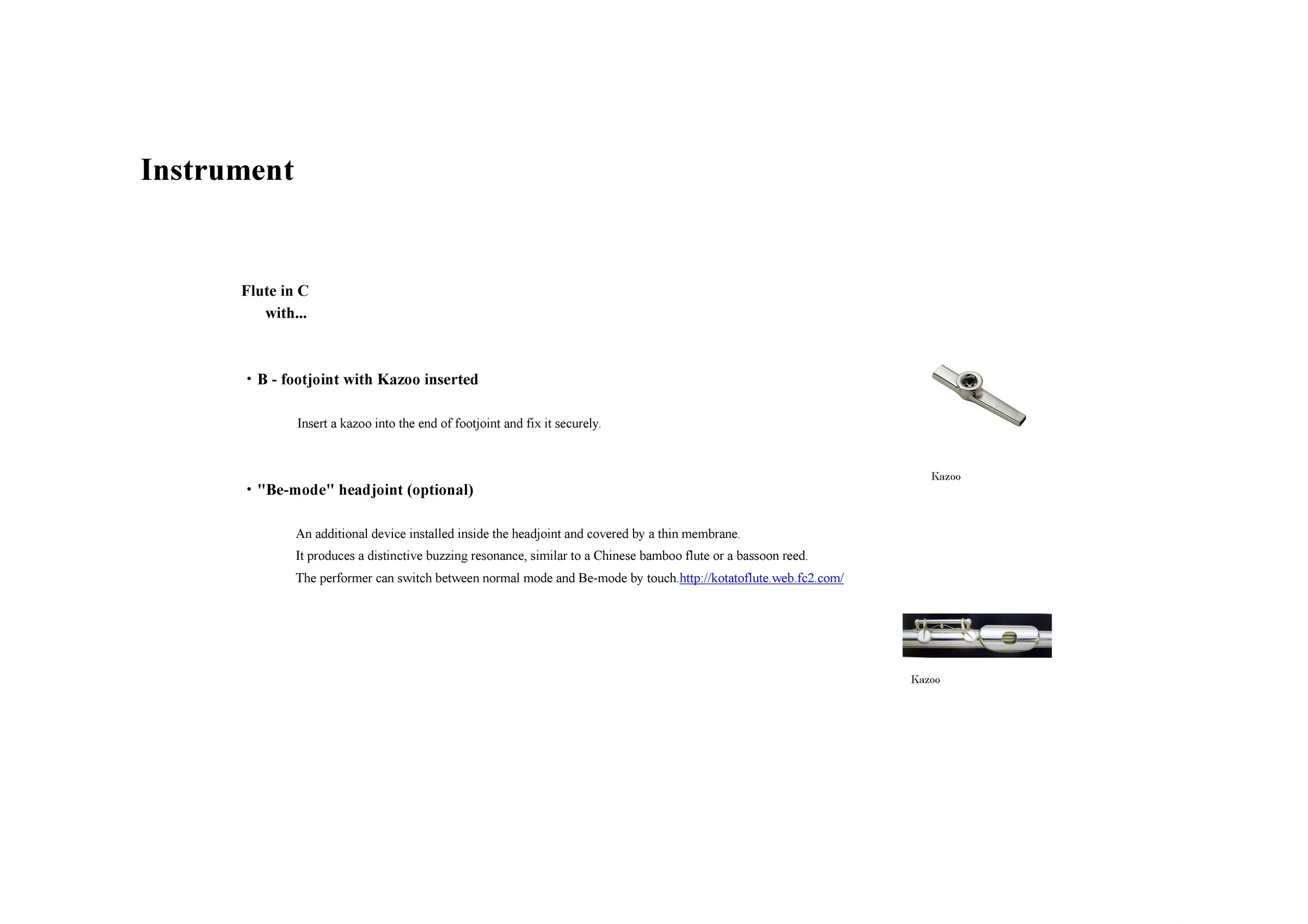
- "Be-mode" headjoint by Kotato & Fukushima flutes
- B-footjoint with Kazoo inserted into the end of footjoint
Recorded and edited by Hiromichi KITAZUME
- Performer Credits
- Jun-ichiro TAKU
- External Links