1 / 29
0:00/0:00
Saxophone Quartet
2023
Saxophone
- Program Notes
Ituri is the name of a forest in central Africa of which some areas are inhabited by the pygmy people. The music of the pygmies has become world famous for its use of complex polyrhythms, cells of different sizes and structure, which superimposed create a complex metrical structure, unknown in Western music. This music, along with Stockhausen's more esoteric pieces were the main sources of inspiration for this quartet. Composed primarily with the gaze set on the barren, wild expanses of rock, swept by the incessant wind, of the island of Lanzarote, this piece does not unfold over time, but is rather a space, static and in constant motion, that slowly envelops the listener, inducing more than active listening, a state of meditative coexistence in the music.
It is not a piece of which one can appreciate the details, but rather a hymn to nature in its wildest state, a nature not on a human scale, but of which, precisely because of this, man becomes a part, and by distancing himself from civilization he enters into communion with it, and consequently with himself. Not, however, an idealization of man in his natural state, but a contemplation of nature in its rawest and most inhospitable state.
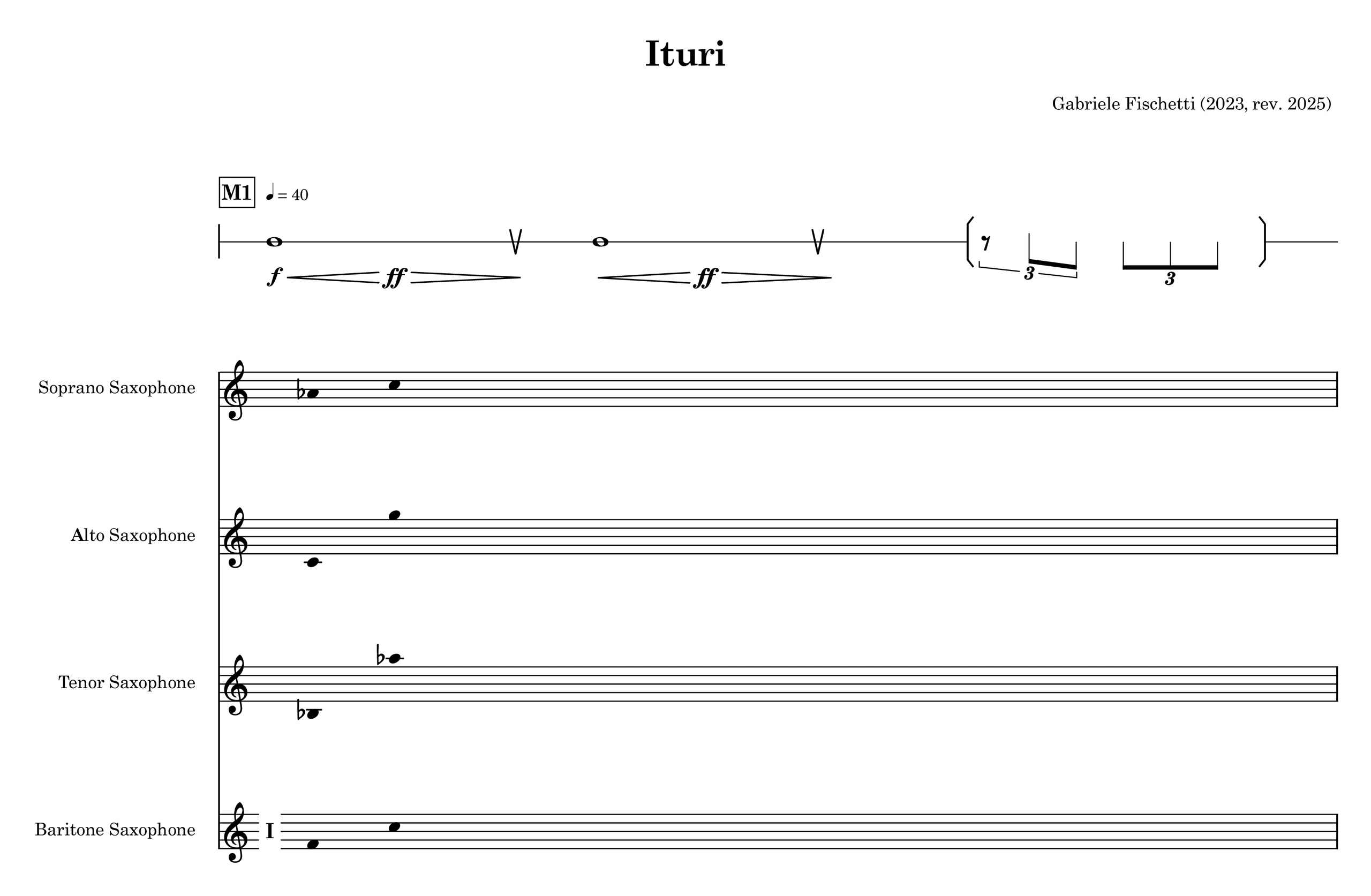
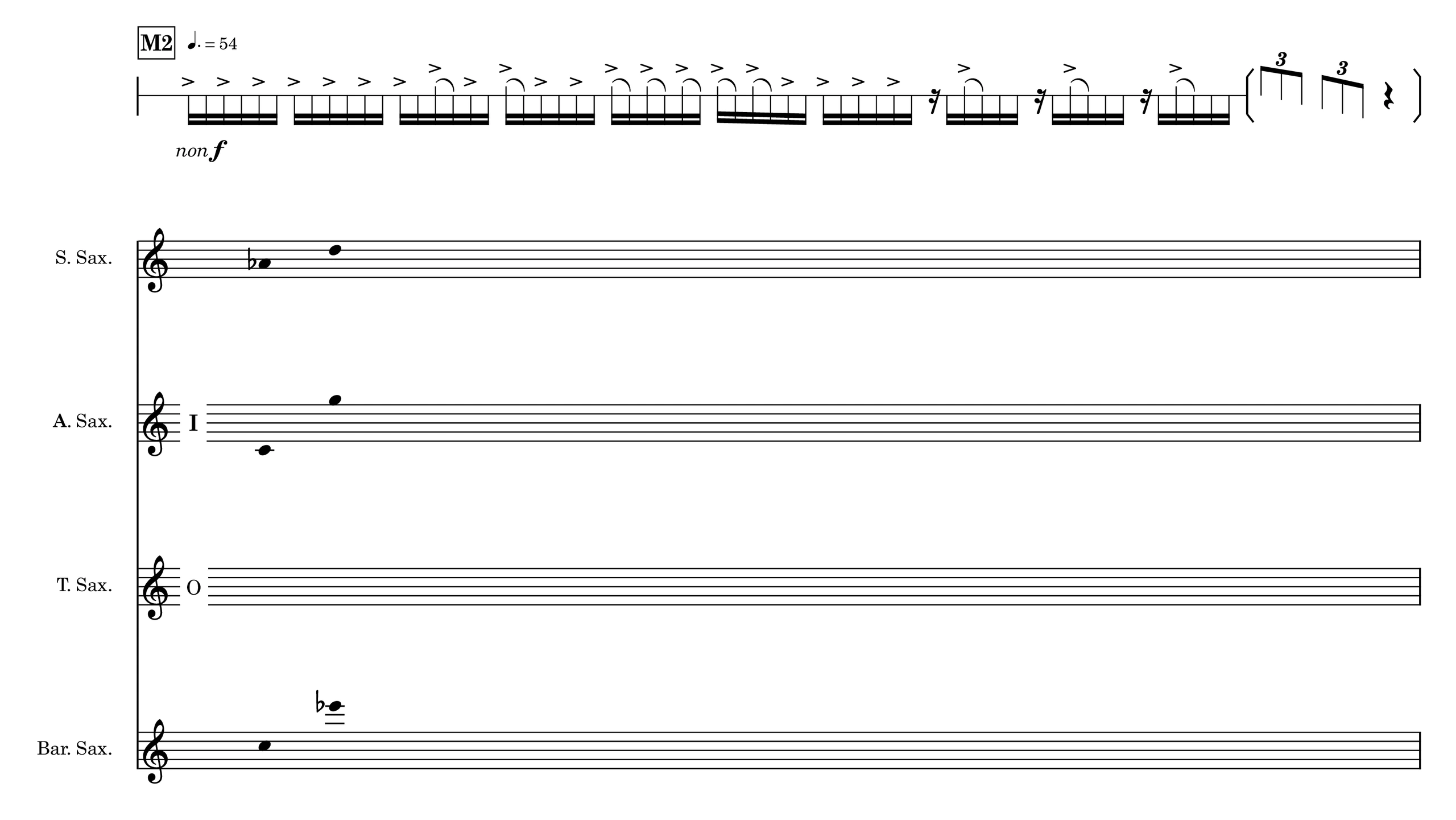
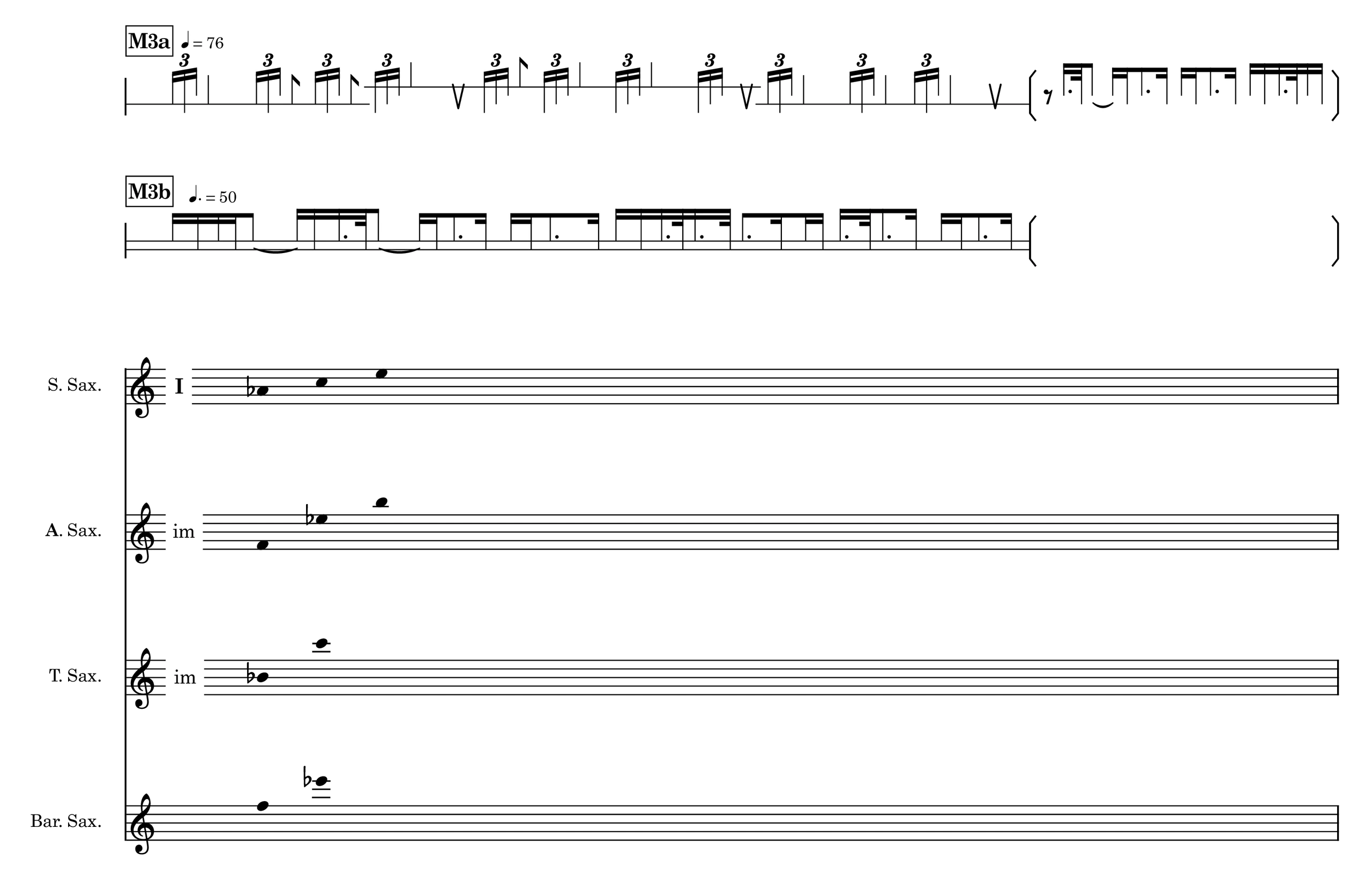
The piece is divided into 23 sections, each containing one or more patterns, or rhythmic cells, to be performed, repeated, varied, dirtied with other material, as well as three sections of free improvisation and three interludes. Performers are also free to choose the patterns to be performed, the pitches among those provided, and the duration of each pattern, and thus of the piece. The rather rigid structure that is superimposed on this aleatoric logic serves to give solidity and at the same time complexity, vitality to the form of the piece.
Each parameter of the piece is organized according to an arching, or sinusoidal structure, never identical to that of each other parameter. The movement of all of the piece's parameters independently therefore makes each section unique, in that it will possess a combination of parameters that cannot be repeated, and makes the shape of the piece both cyclic and linear, symmetrical and without repetition, with a constant return of the same elements in ever-changing contexts.
First of all, the harmony, based on the harmonic series of A-flat, follows an arched structure. The first section presents the series strongly filtered, consisting of only four harmonics, the number of which goes up from section to section, parallel to a slow shift in register, until we reach the eleventh section, where we find the complete series up to the eighteenth harmonic. In the middle of the piece the series drops a semitone and then immediately rises again, repeating its development in reverse until the end of the piece. The number of patterns per section follows a similar path as the harmonic development, but at twice the speed, reaching maximum complexity after a quarter of the piece and reaching minimum complexity in the middle of the piece, where for the duration of one section no patterns are presented. In the second half of the piece this movement is repeated, with small variations. Instead, the tempo follows a sinusoidal structure, starting at the slowest tempo present on the analog metronome, 40 bpm, increasing to 200 bpm, falling back again and finally rising to the fastest tempo on the analog metronome, 208 bpm. Finally the material follows a process of continuous variation, tracing, albeit very loosely, an arc, or cyclic, shape. From a static beginning the first rhythmic figures begin to emerge, at first simple, regular, then more complex, melodic outlines begin to become broader, then different sound effects come into play. Gradually the figures begin to contract again and return to very simple cells, until, after the last upward thrust, the music stops.
- Recording Notes
Recorded at the Conservatoire national supérieur de musique et de danse de Paris.
30/06/2025
- Performer Credits
- Quartet Archipel (Pierre Faget, Thomas Sinoimeri, Takaya Minami, Salvatore Alessandro Miceli)