1 / 74
0:00/0:00
Pierrot + Percussion
2025
Cello
Clarinet
Flute
Piano
Violin
Percussion
- Program Notes
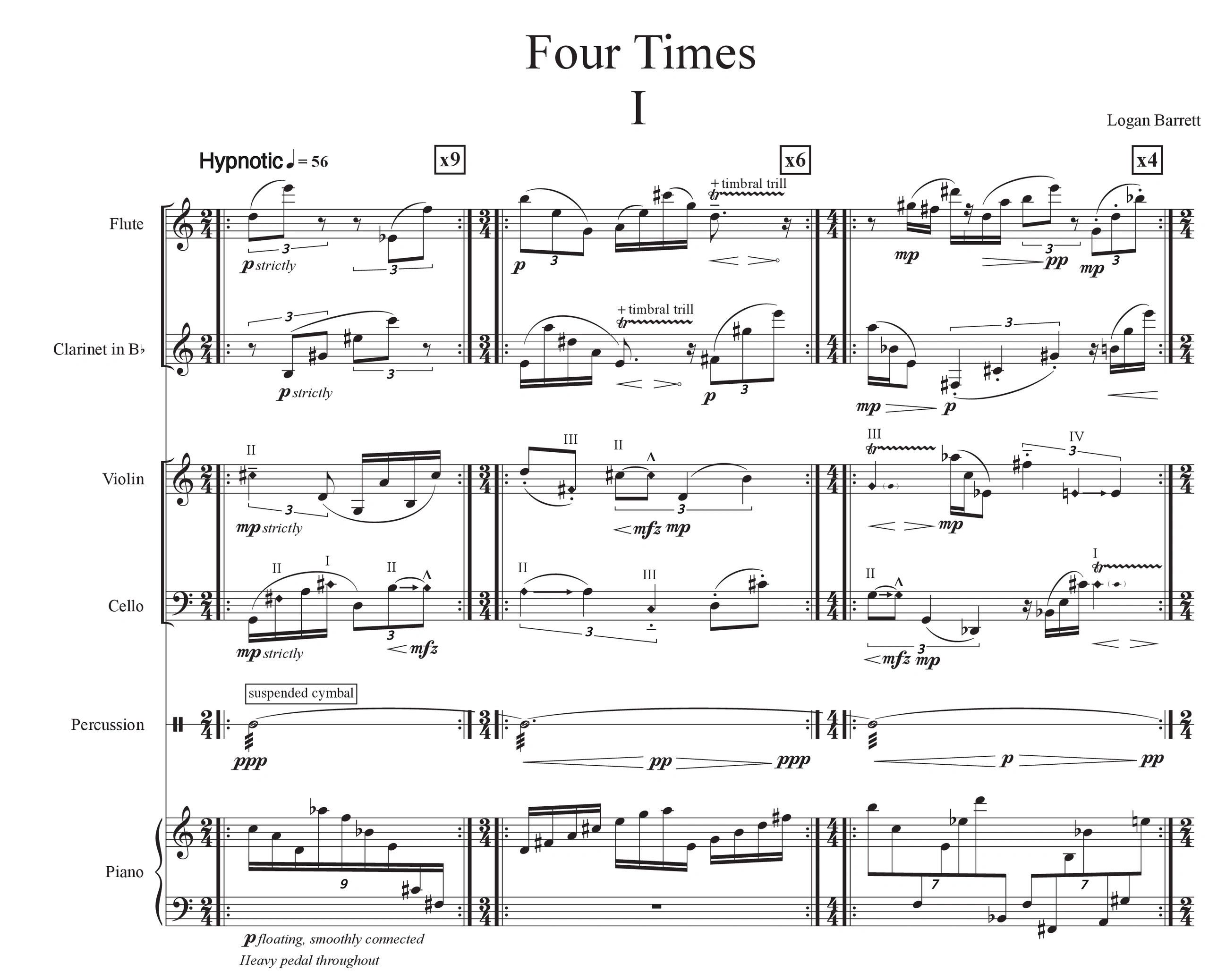
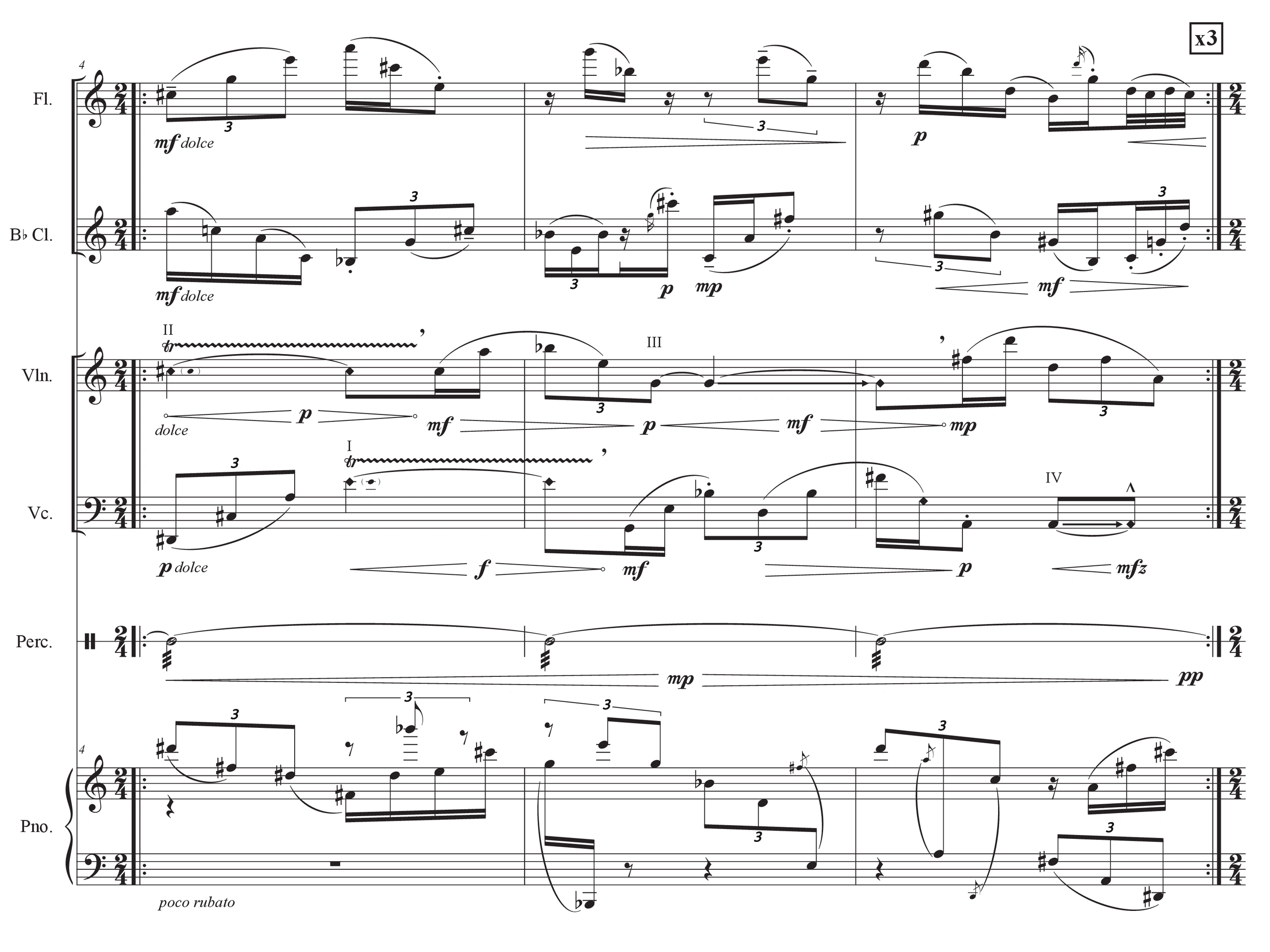
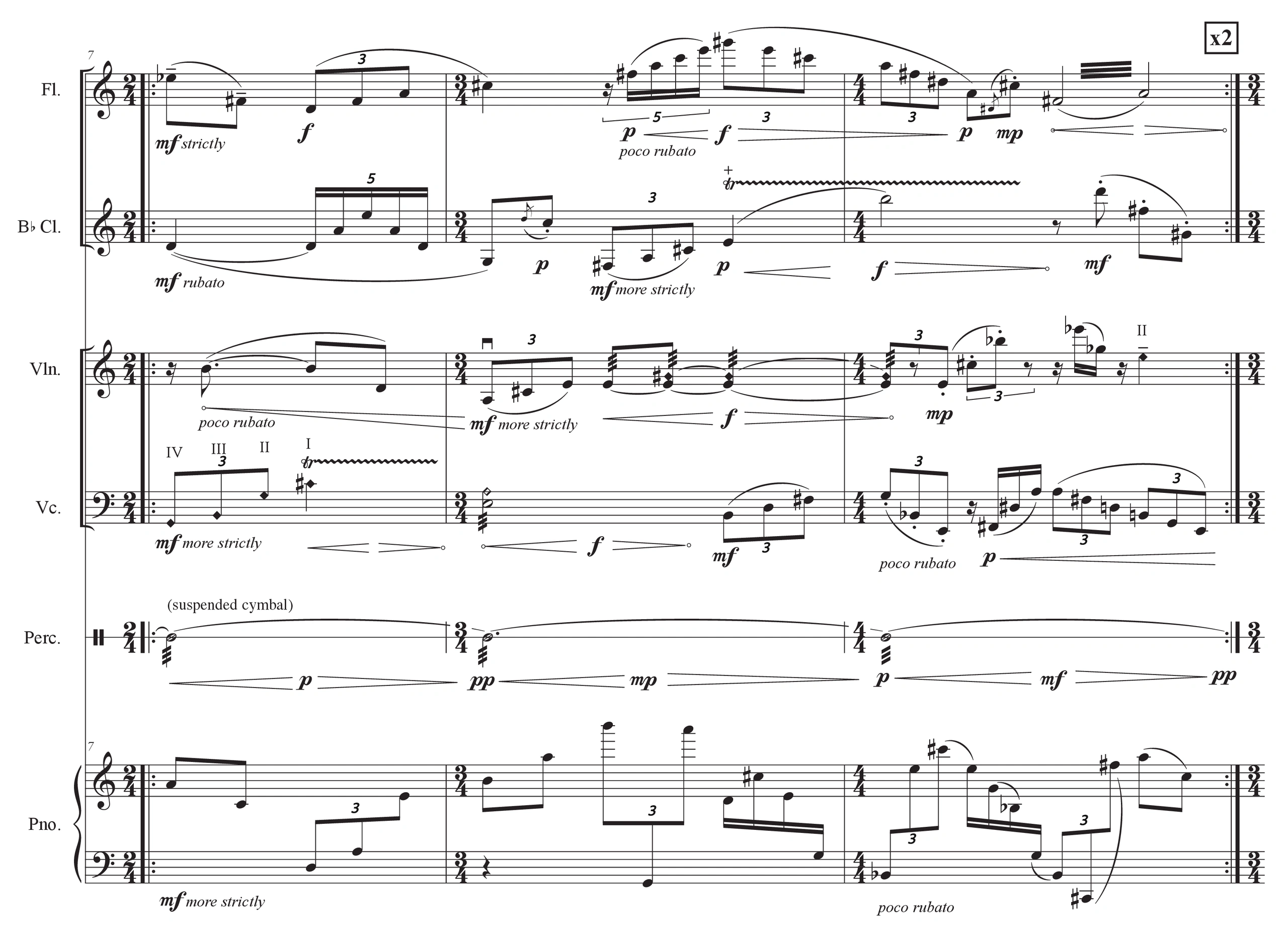
- While time is so obviously a primary feature of music, I often avoid engaging with it directly as a composer, relying on rational techniques to project material through time. Writing this piece near the end of my graduate studies, I sensed my own relationship with time changing, and this shaped the piece in ways I didn't fully understand while composing it. The form of the piece takes inspiration from William Faulkner's The Sound and the Fury, where each chapter has a different narrator and takes place at a different time. Each character processes time differently, and the same objective events of the plot are understood in completely different ways. Rather than a narrative which progressively reveals itself over the course of reading, it is one which can only be understood in retrospect, through contemplating the relationships between chapters. Four Times, in many ways, attempts to evoke this narrative in music, taking on a similar form of four independent movements, each with its own set of aesthetics and techniques. The movements were composed more or less simultaneously; I regularly switched between movements in the same composing session and delayed choosing their forms and ordering until quite late in the process. Material is reused and interjected in different musical contexts. It wasn't until months after finishing the piece that I realized it was not really about avoiding linear time, but confronting it. While I had thought of the compositional process as one to encourage nonlinear thinking, now I unmistakably hear the arc of the piece as one which develops linearly. In fact, the musical structure itself progresses from music which resists time to music which embraces it. The first movement is a palindrome: a highly calculated form that, for me, embodies resistance to the passage of time. Later movements deal with time in increasingly chaotic ways, gradually giving way to the fourth movement which takes an organic and entirely unplanned form. The ending also includes overt uses of tonality, an archetypal instantiation of linear time and a technique I had largely avoided in my own music until this piece.
- Recording Notes
- Performer Credits
- Ensemble Music Nova: Ray Zheng, flute; Jay Kline, clarinet; Sasch Burhop, violin; Tyler Brown, cello; Taya Promenuk, piano; Aiden Hughes, percussion; Peiwen Zou, conductor
- Publisher
- Logan Barrett