1 / 11
0:00/0:00
Solo
2023
Piano
- Program Notes
Lachtherapie [Laughter Therapy]
‘All too often, when the disease is well advanced, some people adopt their own facial expressions, laugh, grin, bare their teeth, mumble, talk to themselves, purse their lips and grimace strangely, with inarticulate speech and exclamations etc.’ In his writing on melancholy, first published in 1621, Robert Burton describes laughter as a symptom of serious illness. At no point is laughter discussed as a human sound that could have something to do with merriment – rather, ‘uncontrollable laughter’ in particular, is listed as a pathological manifestation directly alongside ‘weeping, groaning, sobbing’.
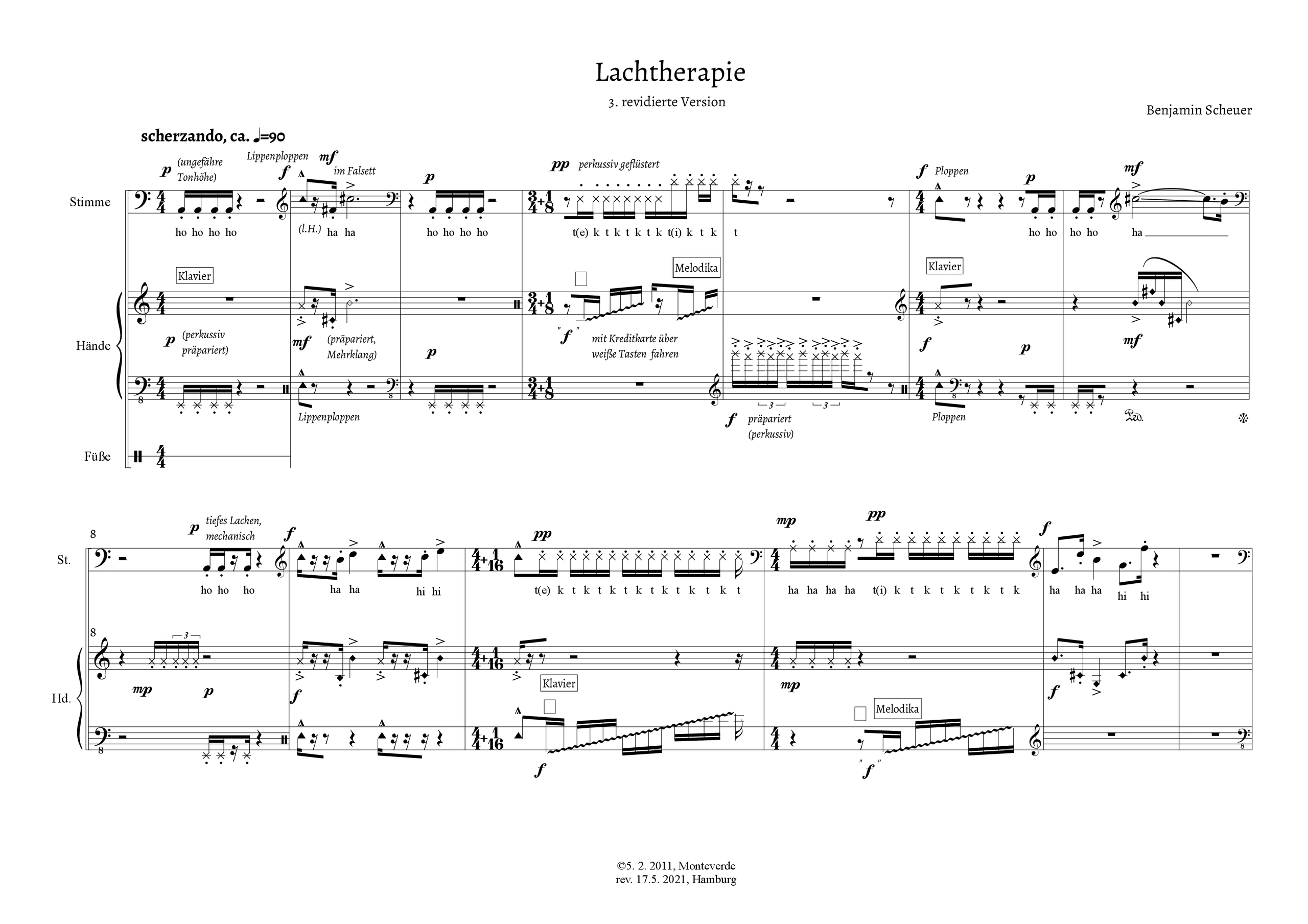
One could have a go at listening to Benjamin Scheuer’s Lachtherapie, titled as a Performance for a Pianist, as a deadly serious piece. A piece about laughter that presupposes a loss of control and can thus become a danger: one only has to think of the forbidden comedy in Umberto Eco’s The Name of the Rose or the tradition of Easter laughter, in which one laughs in the face of death, certain of eternal life. Scheuer notates laughter for the pianist almost laconically in the score. ‘Hohoho’ or ‘haha hihi’ it says, also not forgetting the foot-played squeaker.
The seriousness of the piece lies precisely in the precise and objective notation of laughter: comedy must be precise, otherwise it goes awry and becomes more embarrassing than amusing. Therein lies the quality of Benjamin Scheuer’s music: it ventures to the threshold of pain and, by dropping confetti-madness bombs with surgical precision, attains a depth that is reserved for good comedy: ‘Tutto nel mondo è burla’ as it is said in Verdi’s Falstaff – and this motto also seems to apply to some of Benjamin Scheuer’s pieces. ‘Tutti gabbati’, we are all fools! Luckily!
[by Gordon Kampe]
- Recording Notes
Recording on:
Benjamin Scheuer - Impulsive Lieder
Schott WERGO ((WER 64452)
Sound engineer: Karola Parry
There is also a video that could be used for a video-score.
- Record Label
- WERGO
- Performer Credits
- Nikolai Rosenberg
- Publisher
- score self-published
- External Links