
1 / 98
0:00/0:00
Ensemble
2024
Double Bass
Drum Set
Electric Guitar
Electronic Keyboard
Saxophone
Trombone
Violin
- Program Notes
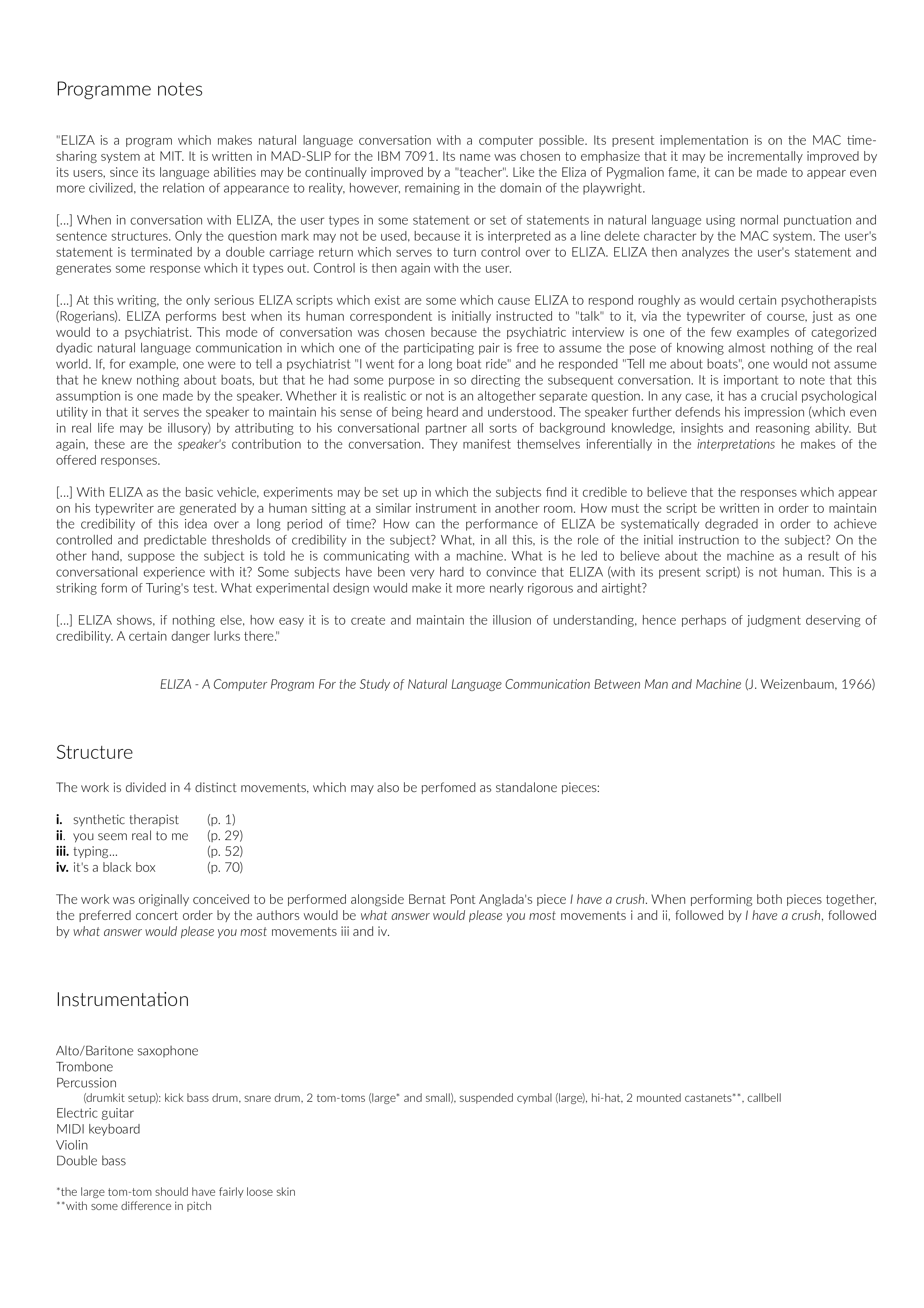
"ELIZA is a program which makes natural language conversation with a computer possible."
"ELIZA was a program consisting mainly of general methods for analyzing sentences and sentence fragments, locating so-called key words in text, assembling sentences from fragments, and so on. It had, in other words, no built-in contextual framework or universe of discourse. In a sense ELIZA was an actress who commanded a set of techniques but who had nothing of her own to say. The script, in turn, was a set of rules which permitted the actor to improvise on whatever resources it provided."
"The first extensive script I prepared for ELIZA was one that enabled it to parody the responses of a nondirective psychotherapist in an initial psychiatric interview. I chose this script because it enabled me to temporarily sidestep the problem of giving the program a data base of real-world knowledge."
"If, for example, one were to tell a psychiatrist "I went for a long boat ride" and he responded "Tell me about boats", one would not assume that he knew nothing about boats, but that he had some purpose in so directing the subsequent conversation. (...) it has a crucial psychological utility in that it serves the speaker to maintain his sense of being heard and understood."
"Nevertheless, ELIZA created the most remarkable illusion of having understood in the minds of the many people who conversed with it. (...) They would often demand to be permitted to converse with the system in private, and would, after conversing with it for a time, insist, in spite of my explanations, that the machine really understood them."
"This reaction to ELIZA showed more vividly than anything I had seen hitherto the enormously exaggerated attributions an even well-educated audience is capable of making, even strives to make, to a technology it does not understand. (...) Difficult questions arise out of these observations; what, for example, are the scientist’s responsibilities with respect to making his work public? And to whom (or what) is the scientist responsible?"
"ELIZA shows, if nothing else, how easy it is to create and maintain the illusion of understanding, hence perhaps of judgment deserving of credibility. A certain danger lurks there."
Joseph Weizenbaum (1923-2008), computer scientist and creator of ELIZA
- Recording Notes
Recording from the world premiere at Auditorio de Galicia (Santiago de Compostela, Spain) by the ensemble Vertixe Sonora.
- Performer Credits
- Vertixe Sonora
- External Links