1 / 9
0:00/0:00
String Quartet
2023
violin
viola
cello
- Program Notes
The ship wherein Theseus and the youth of Athens returned from Crete had thirty oars, and was preserved by the Athenians down even to the time of Demetrius Phalereus, for they took away the old planks as they decayed, putting in new and stronger timber in their places, insomuch that this ship became a standing example among the philosophers, for the logical question of things that grow; one side holding that the ship remained the same, and the other contending that it was not the same.
--Plutarch, Life of Theseus 23.1
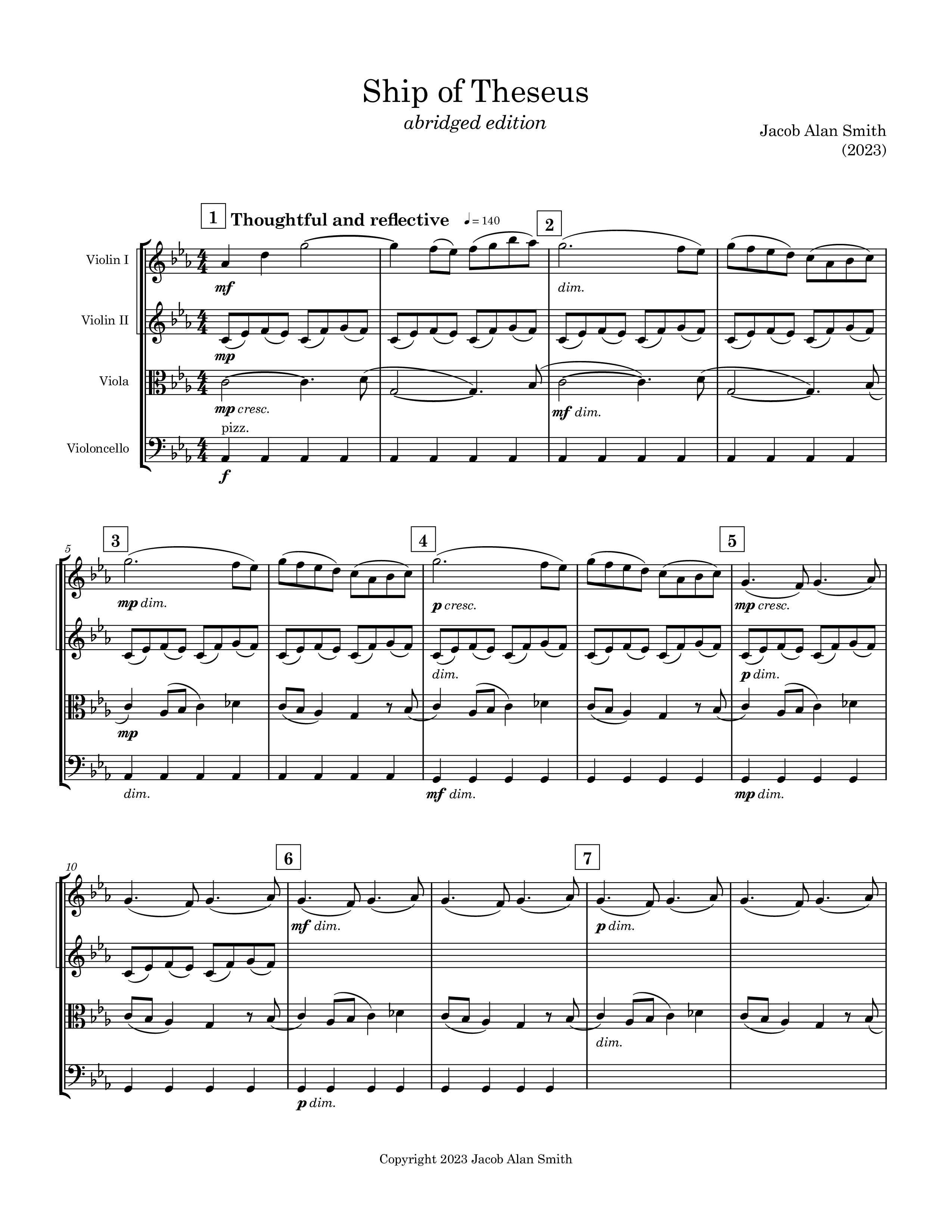
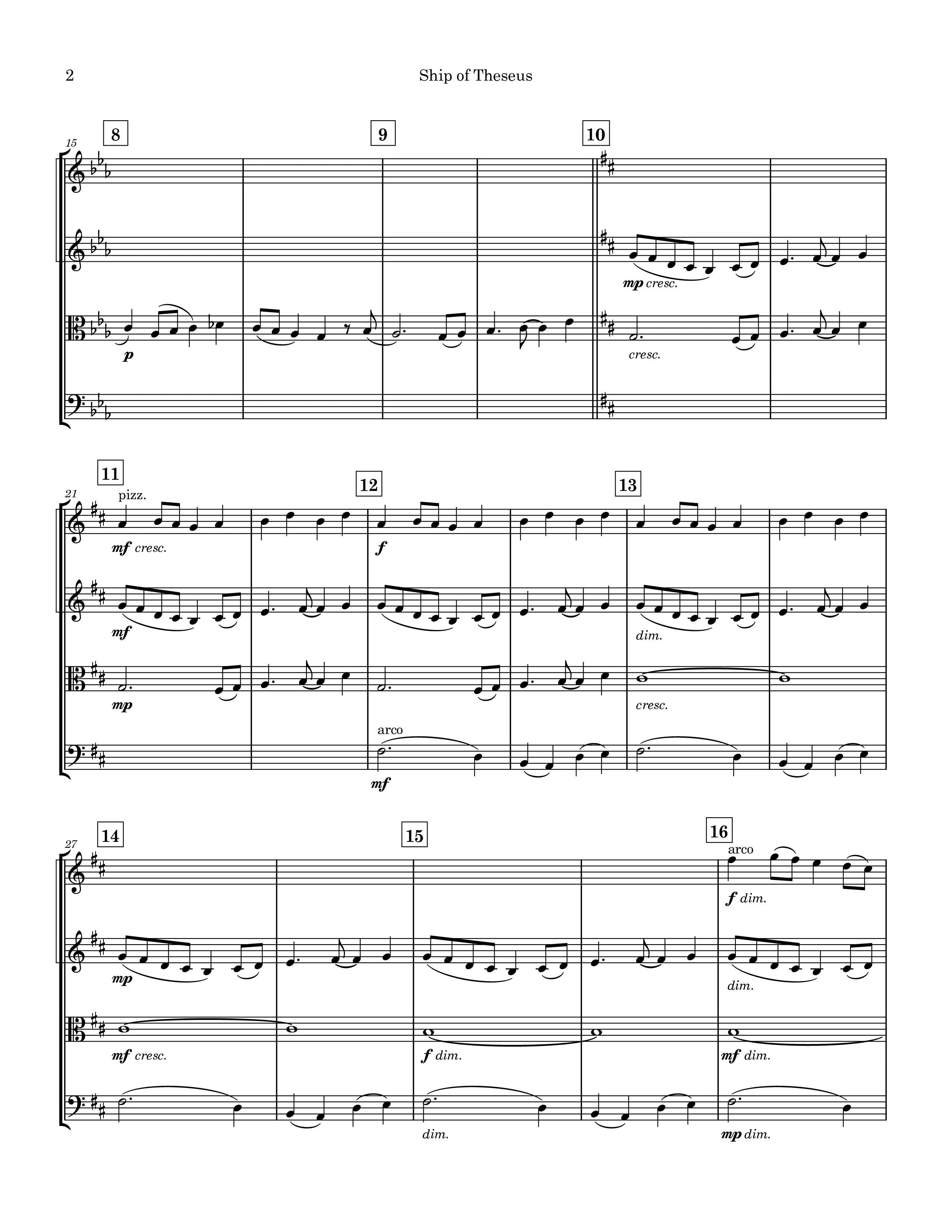
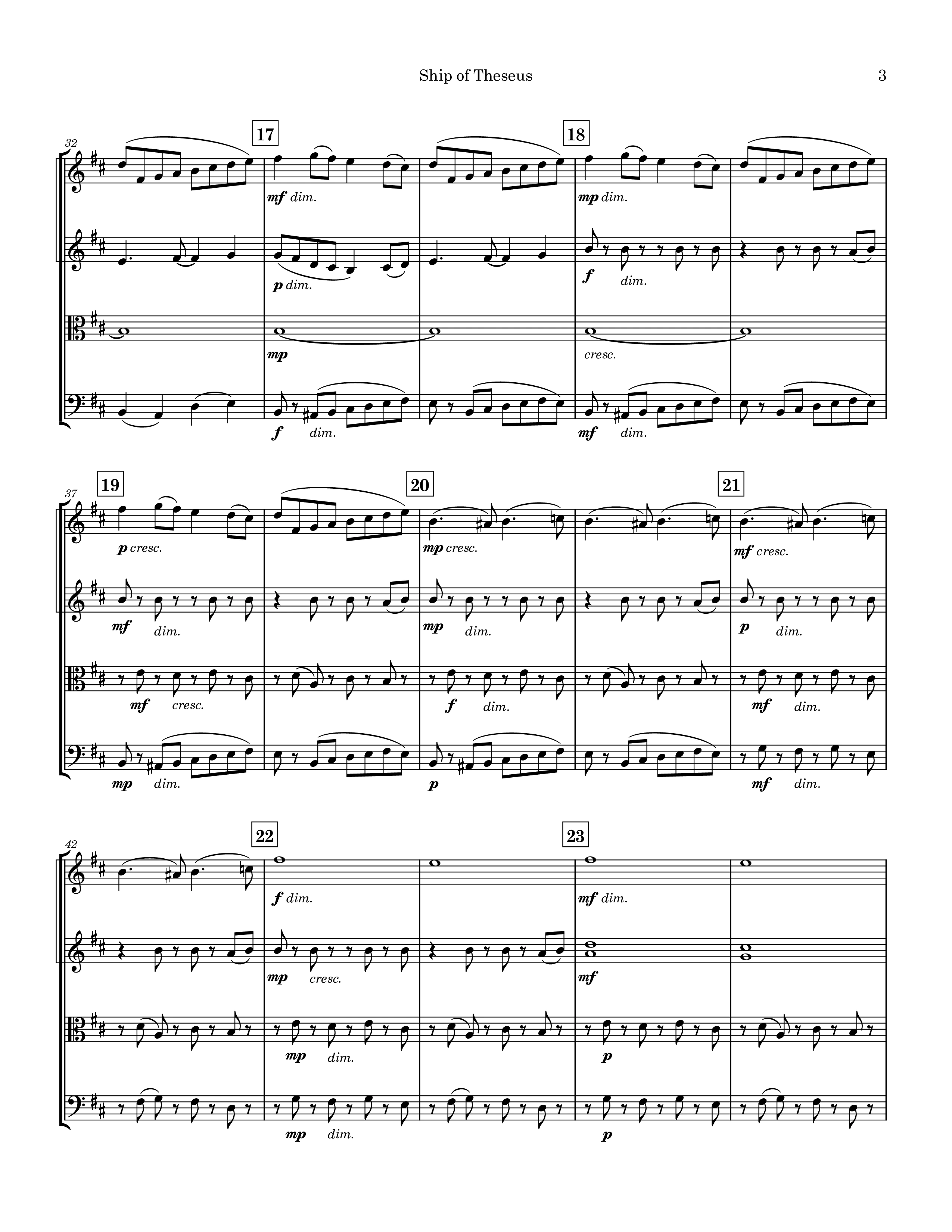
Based on the long-debated Ship of Theseus thought experiment, which debates whether or not a ship that has gradually had all of its parts replaced is the same ship as when it was first built, this work of the same name was compositionally constructed in a manner that echoes the original question. Composed using a set of rigid restrictions (listed below), the piece is broken up into 54 two-measure segments, each of which can be repeated indefinitely according to the performer’s wishes. Each segment is identical to the last, with the exception of one of the instrumental parts, which changes in response to the flow of the piece. As each instrument’s parts change, the music gradually morphs in tone and texture, and each following segment strays further from its origin as melodies, harmonies, and rhythms are “replaced,” one by one. Which parts get replaced when was decided solely according to the musical flow of the piece, to avoid excessive repetition (despite the nature of its construction). The only aspect that could be altered in all parts simultaneously is the dynamic contrast—despite parts repeating themselves through segments, they can come forward or sink back into the sonic landscape to maintain a variable flow.
Ship of Theseus—original guidelines used for composition:
The piece is to be broken up into two-measure “segments,” each of which is labeled with a number. Each of these segments must be able to be repeated indefinitely.
In these segments, three of the parts must be identical to that of the last segment, and one of them is to be different. This applies to every aspect of the music except the dynamics, which are allowed to differ in all parts to maintain a level of contrast and variation that would stop the piece from being annoyingly repetitive.
Crescendos and decrescendos are allowed, but should be marked in parentheses to denote that they only apply to the final repetition of the segment.
No part can change twice in a row, to prevent one part from being too dominant. Which part changes when is decided according to the progressive flow of the piece.
Jacob Alan Smith
July 23, 2023
- Recording Notes
Recorded September 23, 2023
Creativity and Innovation District at Virginia Tech, Blacksburg, VA, USA
- Performer Credits
- Beo String Quartet: Jason Neukom, violin I; Andrew Giordano, violin II; Sean Neukom, viola; Ryan Ash, cello
- External Links