1 / 31
Never tell me if I can double instruments, especially if those instruments are more on the unconventional side. When I stumbled upon the Frank Abell competition on the 30th of August (one day before I’m writing this and two days before the deadline I started to panic. I had initially planned to submit something I already had written to see what would happen. Good thing I checked the requirements, but as I was looking over them, I noticed that they allowed doubling. A lot of it. That’s when the ideas started coming. As I looked over the doubles, I thought “huh, these would be quite strange together” and thus, Oddballs was formed.
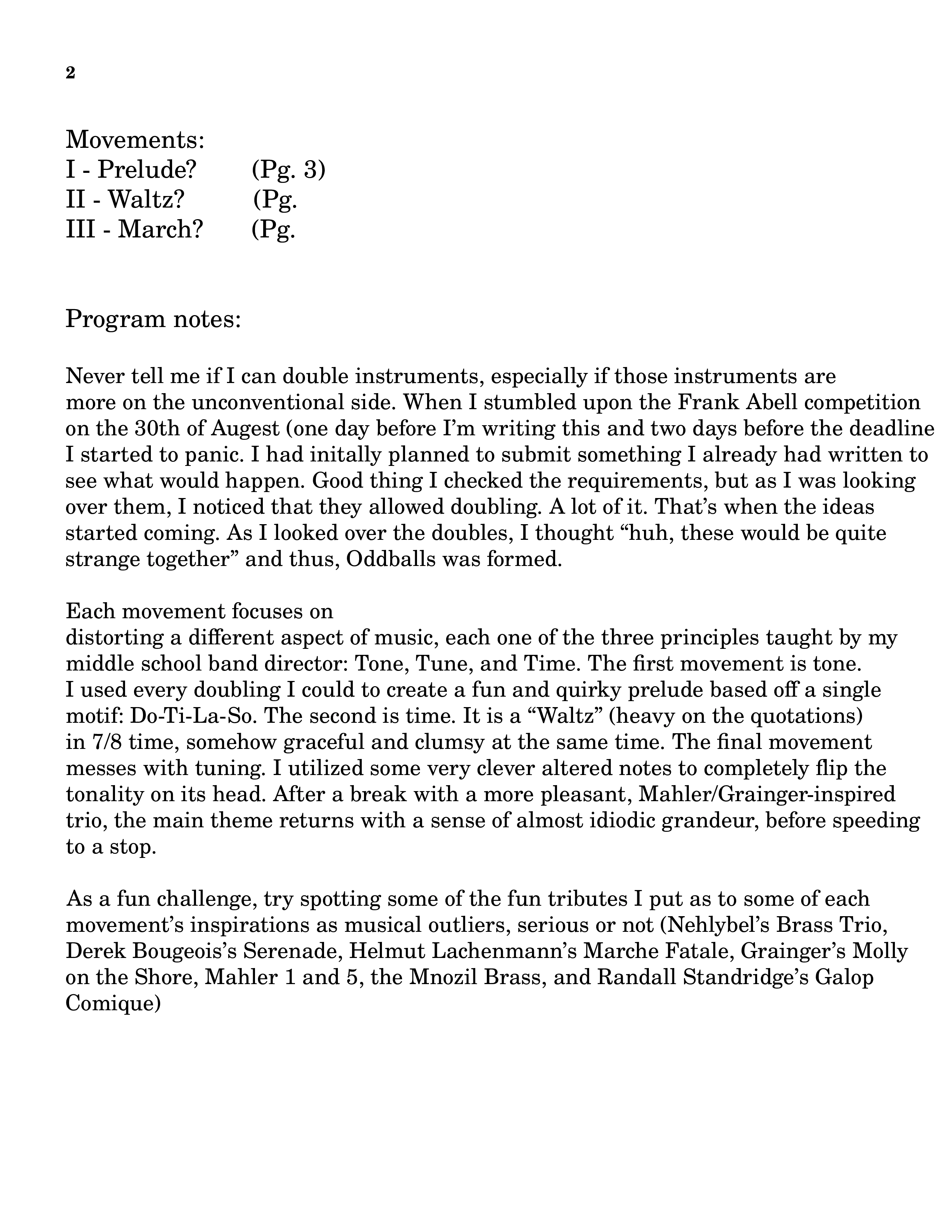
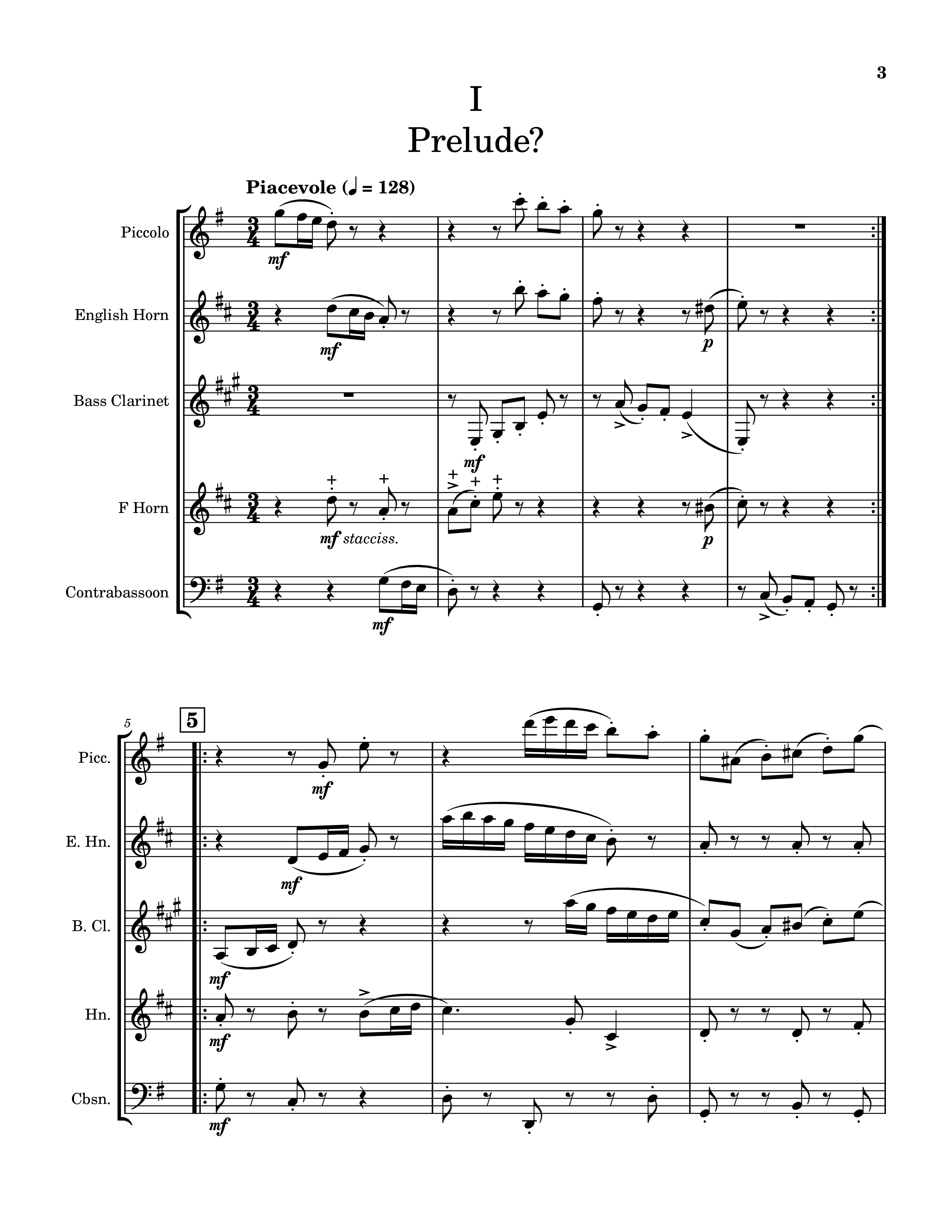
Each movement focuses on distorting a different aspect of music, each one of the three principles taught by my middle school band director: Tone, Tune, and Time. The first movement is tone. I used every doubling I could to create a fun and quirky prelude based off a single motif: Do-Ti-La-So. The second is time. It is a “Waltz” (heavy on the quotations) in 7/8 time, somehow graceful and clumsy at the same time. The final movement messes with tuning. I utilized some very clever altered notes to completely flip the tonality on its head. After a break with a more pleasant, Mahler/Grainger-inspired trio, the main theme returns with a sense of almost idiodic grandeur, before speeding to a stop.
As a fun challenge, try spotting some of the fun tributes I put as to some of each movement’s inspirations as musical outliers, serious or not (Nelhybel’s Brass Trio, Derek Bourgeois's Serenade, Helmut Lachenmann’s Marche Fatale, Grainger’s Molly on the Shore, Mahler 1 and 5, the Mnozil Brass, and Randall Standridge’s Galop Comique).
It's a midi recording using Musesounds for all the woodwinds and Berlin Brass for the horn. Consequently, not all effects are portrayed particularly well, especially stopped horn, which is non-existent.