1 / 16
0:00/0:00
Trio
2020
- Program Notes
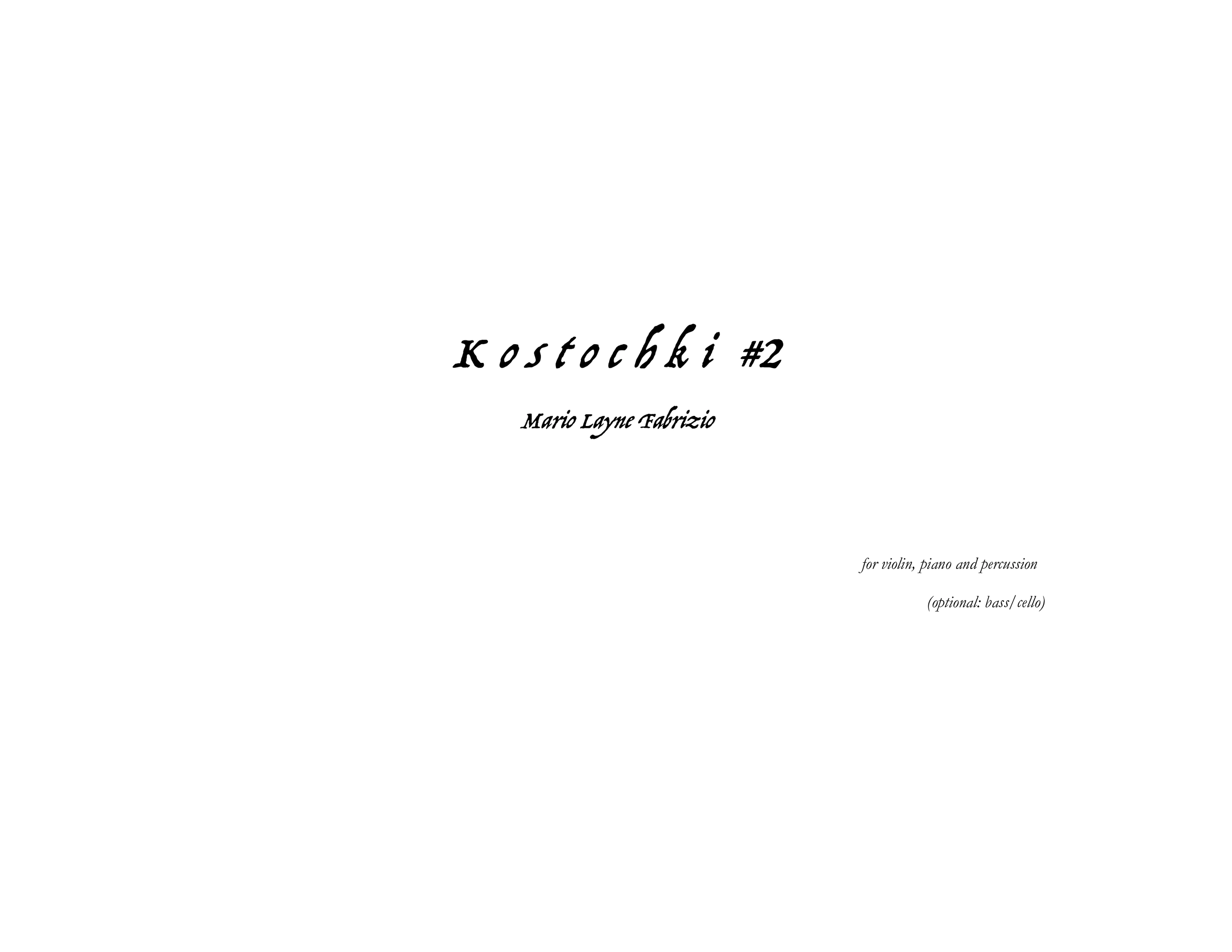
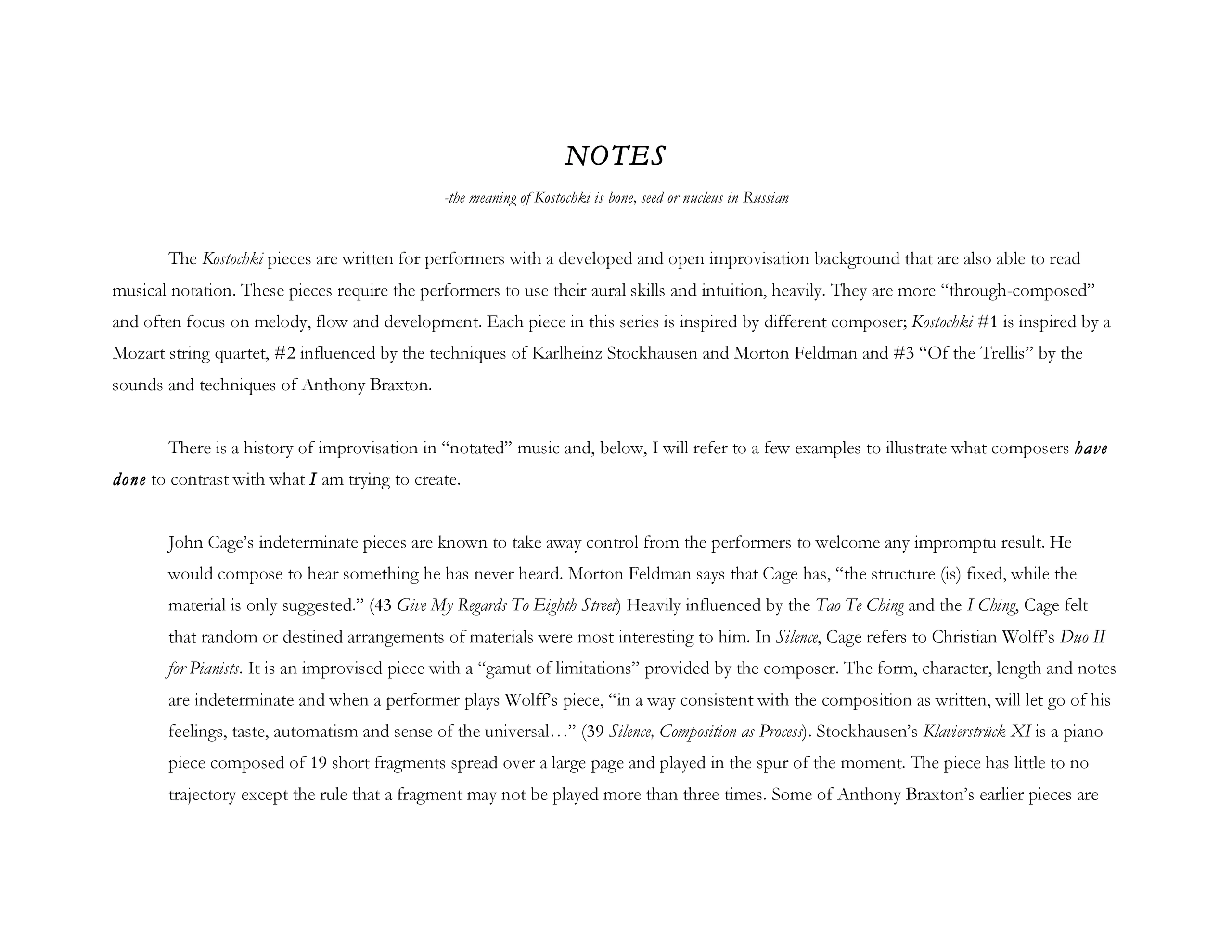
NOTES -the meaning of Kostochki is bone, seed or nucleus in Russian
The Kostochki pieces are written for performers with a developed and open improvisation background that are also able to read musical notation. These pieces require the performers to use their aural skills and intuition, heavily. They are more “through-composed” and often focus on melody, flow and development. Each piece in this series is inspired by different composer; Kostochki #1 is inspired by a Mozart string quartet, #2 influenced by the techniques of Karlheinz Stockhausen and Morton Feldman and #3 “Of the Trellis” by the sounds and techniques of Anthony Braxton.
There is a history of improvisation in “notated” music and, below, I will refer to a few examples to illustrate what composers have done to contrast with what I am trying to create.
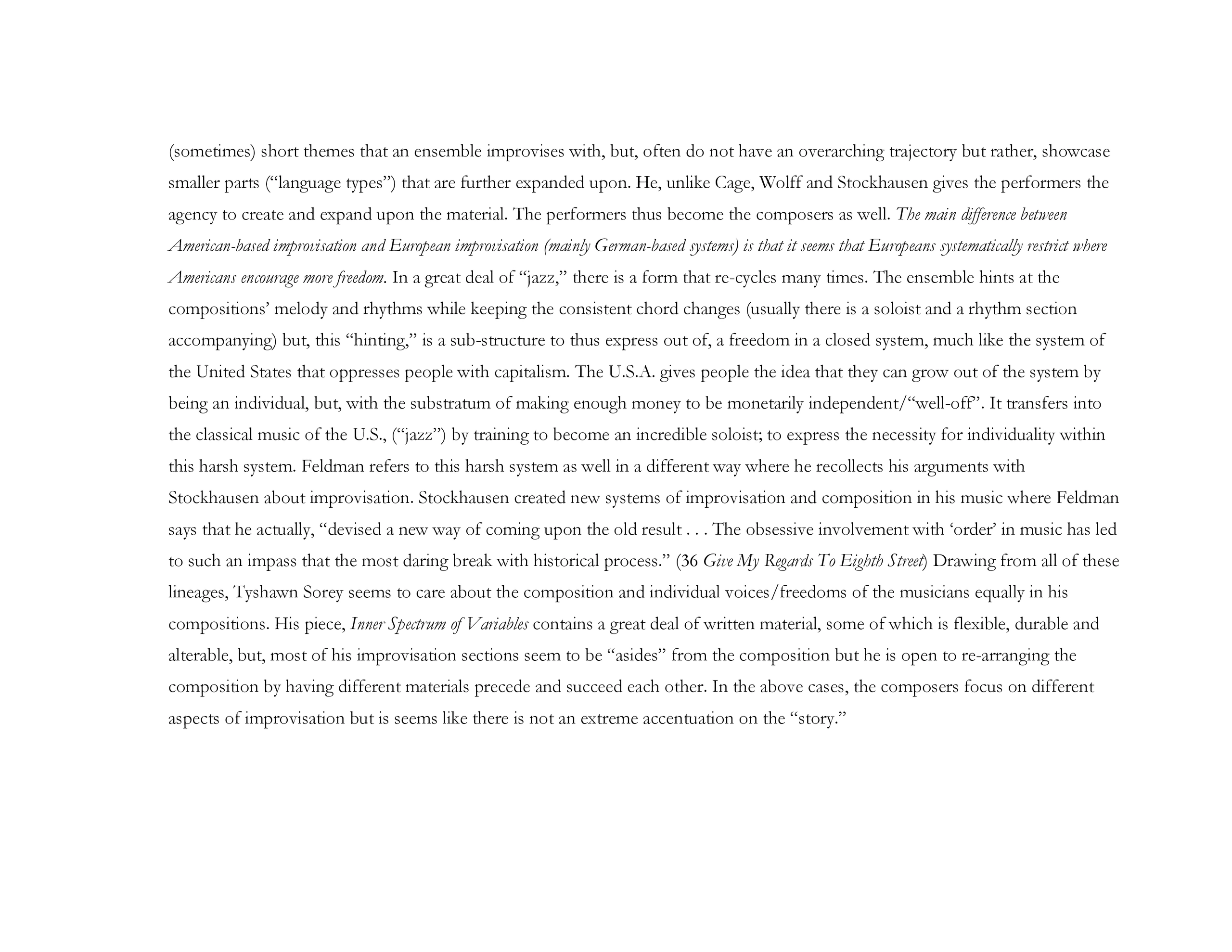
John Cage’s indeterminate pieces are known to take away control from the performers to welcome any impromptu result. He would compose to hear something he has never heard. Morton Feldman says that Cage has, “the structure (is) fixed, while the material is only suggested.” (43 Give My Regards To Eighth Street) Heavily influenced by the Tao Te Ching and the I Ching, Cage felt that random or destined arrangements of materials were most interesting to him. In Silence, Cage refers to Christian Wolff’s Duo II for Pianists. It is an improvised piece with a “gamut of limitations” provided by the composer. The form, character, length and notes are indeterminate and when a performer plays Wolff’s piece, “in a way consistent with the composition as written, will let go of his feelings, taste, automatism and sense of the universal...” (39 Silence, Composition as Process). Stockhausen’s Klavierstrück XI is a piano piece composed of 19 short fragments spread over a large page and played in the spur of the moment. The piece has little to no trajectory except the rule that a fragment may not be played more than three times. Some of Anthony Braxton’s earlier pieces are
(sometimes) short themes that an ensemble improvises with, but, often do not have an overarching trajectory but rather, showcase smaller parts (“language types”) that are further expanded upon. He, unlike Cage, Wolff and Stockhausen gives the performers the agency to create and expand upon the material. The performers thus become the composers as well. The main difference between American-based improvisation and European improvisation (mainly German-based systems) is that it seems that Europeans systematically restrict where Americans encourage more freedom. In a great deal of “jazz,” there is a form that re-cycles many times. The ensemble hints at the compositions’ melody and rhythms while keeping the consistent chord changes (usually there is a soloist and a rhythm section accompanying) but, this “hinting,” is a sub-structure to thus express out of, a freedom in a closed system, much like the system of the United States that oppresses people with capitalism. The U.S.A. gives people the idea that they can grow out of the system by being an individual, but, with the substratum of making enough money to be monetarily independent/“well-off”. It transfers into the classical music of the U.S., (“jazz”) by training to become an incredible soloist; to express the necessity for individuality within this harsh system. Feldman refers to this harsh system as well in a different way where he recollects his arguments with Stockhausen about improvisation. Stockhausen created new systems of improvisation and composition in his music where Feldman says that he actually, “devised a new way of coming upon the old result . . . The obsessive involvement with ‘order’ in music has led to such an impass that the most daring break with historical process.” (36 Give My Regards To Eighth Street) Drawing from all of these lineages, Tyshawn Sorey seems to care about the composition and individual voices/freedoms of the musicians equally in his compositions. His piece, Inner Spectrum of Variables contains a great deal of written material, some of which is flexible, durable and alterable, but, most of his improvisation sections seem to be “asides” from the composition but he is open to re-arranging the composition by having different materials precede and succeed each other. In the above cases, the composers focus on different aspects of improvisation but is seems like there is not an extreme accentuation on the “story.”
Now, I can best describe my vision of using improvisation in the Kostochki pieces from a quote in Dane Rudhyar’s book, The Astrology of Personality. He says, “The whole and parts mutually and reciprocally influence and modify each other . . . wholeness or holism, characterizes the entire process of evolution in an ever increasing measure.” All too often, improvisers use compositions as a way to extend and express their individual and collective technical prowess. Many composers, on the other hand, seem to objectify improvisations as small recreations rather than a gear making a machine (the composition) work. I challenge this problem and I think Kostochki #2 provides one possible solution. It has a long overarching malleable structure where the dominant factors: listening, intuition and the vision of the whole composition, gives this piece life. The performers have agency and they have to work together, breathing as one. They have the ability to change the trajectory, more specifically, the tempo and written material can change based on what the improvisations become and how the written material further develops from the improvisation. Kostochki #2 is constructed with a few themes and sectional loops that are very similar to one another, yet, vary slightly in rhythm, pitch and organized by context - they are further tied together by improvisation. The improvisation is absolutely necessary for this piece to develop, so performers should not treat the improvised sections as an extraneous element or an “aside,” but thoroughly integrated pieces of the whole. Within the loops, one may change the tempo, dynamic, timbre, ornament, note value, note, and rhythm, tastefully to provide contrast, flow, and development. These choices to alter certain characteristics of the material should be made to enhance the structure of the piece as a w h o l e (beginning to middle, beginning to end, middle, to end and end to beginning) and not chosen just for personal flare. These alterations of the looped sections and the evolution of the fully improvised sections can thereby change the written material after, similarly transforming and evolving the piece with regards to tempo, dynamic and character (etc.), unless otherwise notated. The amount of times a section is looped is dictated primarily by the performers’ intuition unless otherwise stated: a section could be repeated twice, fifty, a hundred times (“intuition is holistic perception” The Astrology of Personality). In addition, the notation does not contain all of the “emotional characteristics” that will make the piece “whole” - the improvising musicians must connect with the material to further extend the content. The written material is supposed to be developed by the performers through intense listening, which is why I still consider the Kostochki pieces, compositions for improvisers. This piece, has
a set structure, however, the above changes with regard to characteristics will make this piece feel and sound very different every time performed because “the whole and parts mutually and reciprocally influence and modify each other,” (D. Rudhyar).
-Mario Layne Fabrizio
- Recording Notes
Emma Burge - violin & voice Phillip Golub- piano Mario Layne Fabrizio- percussion, voice, piano
“The whole and the parts mutually and reciprocally modify and influence each other”Dane Rudhyar
These pieces are adventures, are of love, an insatiable desire seeking the pit or the center of our essence but through ease and truth. kostochki means bones, seed, pit in russian, a word Anya Shatilova spoke to me first at NEC in the dining hall. Through wholistic astrology, I have learned about timing throughout the year and a Daoist way of ease and intuitive clairvoyance. Every month, every moon cycle, everyday, and every mood serves a purpose. Like a tree shedding its leaves going dormant to blossoming we humans have cycles in seasons that are unified and parallel. kostochki is a grouping of pieces composed between 2018-2020, and, upon reflecting for years about this music I have found it to remain new and mysterious, sensual, spiritual, romantic, unique and ultimately, powerful throughout my various metamorphoses throughout these past few years. At this same time of composing and beginning these sets of works (2018-2020) I was living at my great friend, mentor and unofficial & official auntie/grandmother Ruth Lepson's house. This place hosted so much magic not only for me but for the greater community of artists, poets, philosophers, musicians, doctors … you name it. Ruth had a house that was for togetherness, for understanding, for development. This place allowed me time to understand and explore knowledge, read, paint, compose and meet many new people as Ruth is an established and wonderful poet and educator who is beloved around the world but very much in Cambridge and in greater Boston. She encouraged me to further my understanding and to research. So many conversations started with her saying “do you know?” When the answer was repeatedly “no” I was reminded that my knowledge was so limited. I began to research and read heavily instead of going back to get a master's degree. My parents, care, about, education - knowledge will set you free. This time at Ruth’s was my master's degree. Mentors like Jason Moran and Vijay Iyer, and artists such as Morton Feldman, Alexander Scriabin, Anthony Braxton, Tyshawn Sorey, Sun Ra, the AACM, Giacinto Scelsi, João Gilberto, and Karlheinz Stockhausen were all in my ears. Partly because of the fanaticism that the New England Conservatory (2014-2018) had about many of these composers, but also my understanding that these composers and mentors were/are doing something original and different. They all were doing something that wasn't done before them. I started to understand that there was a lack of flexibility existing within “flexible” music. I desperately wanted music that was an adventure like in a film. I was on an adventure, Emma Burge and Phillip Golub were the closest most trusted and loved individuals in my life. Emma and I explored the whole US together, we met a magical individual along the way in North Bend named Tom Gorai who invited us to live in his childhood home in Seattle as we visited my old friend Carlos who is another very loved friend with his parents who I have seen as two of the most loving and supportive people whom I consider family and also met up with Julian Weisman, such a good guy . . . such a good guy. Tom listened to this music, he saw us as people he trusted with the future. He invited us to live in Seattle. But when writing this music there was Maine, Ruth's house in Covid, the road trip, the recording, the composing for Emma specifically giving her a piece that would allow her to sing to be completely herself, to show the sensitivity and passionate nature and a spiritual sense that was bright and light grey and interesting, the reading, the essays, the new perspective. I loved David Lynch especially at this time, and he has been a light in the sky for my adventures in life, the blue rose, the owls, the streets, the dreams, the dreams. The pie, the coffee, the coffee. Fellini and Antonioni also changed and enriched my perspective in storytelling with the ability to have stillness and show a richness in a moment. Then that word perspective became my new obsession. It changed to the word dimension. That's where scientists and the mystics came in. What is it to understand and listen and to think in four dimensions? How can we transcend time? How can I communicate with people in the present in four dimensions? Through painting I saw this problem even more! Why am I using a 3D, 2D surface that is in a 3D World to create an illusion by adding on 3D material yet the process in time creates a life completely a 4 dimensional experience? What is it but clairvoyance, understanding past, present and future at once yet allowing it to be improvisatory and flexible knowing that the restriction of medium is there but to understand that the destination is there, yet flexible allowing restriction to be an object of flexibility. This is the way I live life. Through painting, through desire for depth in conversation, in love and in thoughts. The Alchemist, Paolo Coelho Tao Te Ching, Lao Tzu Through more, I found Dane Rudhyar, another light in my sky. Shasta, the Lemurians, Saturn. The ultra-modernist haha I mean futurist, influenced composers like Giacinto Scelsi, and John Cage with his thoughts that were so precise and so beautiful. Rudhyar would speak about astrology in a way that a chart is understood not by your sun sign, or moon sign but as each part of your chart and the whole in being but simultaneously. It is math, not science. It has no application until you incorporate philosophy with it. Because the positions of planets are changing so much every day, every moment, you not being a stationary being but being one that has an essence that is to be developed through understanding each part of mind, love, action, luck, limitation, dreams, emotion, etc (each planet’s representation) but allowing yourself to guide with the times understanding. What part of yourself will shine at any time in history and in the future. This is also the task of the Buddha of clairvoyance and the Alchemy of everything in life to have wholeness. He spoke about music as magic, as magic itself. Tie this to the stars. But now let's do it with music, improvisation and with story. This time in life and at Ruth’s house indelibly changed and altered my life in way too many ways to state but allowed my understanding that I desired to solidify abstraction into a magical realism, a way of creating, living and understanding that engages every moment, lifetime, living being with love and openness and beauty not a halting fear that creates a diminution of one's happiness. -Mario Layne Fabrizio
Mario seems to be able to do whatever intrigues him. When he graduated from New England Conservatory he did some gardening—and what an eye he has for color and proportion—the eye he brings to everything. I asked one of his composition teachers if he could be a major composer. The reply—if he concentrates on it. Everyone should have such a conundrum— choosing to be master of one art or make everything into an art—well, everything he does turns into something artistic and beautiful, not to mention original, and he picks things up right away. He taught himself piano while living at my house and wrote wild compositions so after a while he could actually give concerts. He learned glass-making. He insists on dancing entirely freely—everything in his broad life has to be done freely. He taught himself to be a gourmet cook,Insisting on getting even the carrot chopping just right even though there was work waiting for him in his room. He started making visual art seriously a few years ago and immediately attracted the attention of curators, gallery owners and other artists, and began selling his work. But let me say a word about his poetry—he knows sound and rhythm, as musicians do, but most don’t know how to turn those into verbal meaning right away. He did, and got published right away as well.He is able to express love and freedom and to remind us that the two work together to create this world—in which I am (extremely) happy to know him. -Ruth Lepson
Wu is nothingness, emptiness, no-existence. Thirty spokes of a wheel all join at at a common hub yet only the hole at the center allows the wheel to spin. Clay is molded to form a cup yet only the space within allows the cup to hold water. Walls are joined to make a room yet only by cutting out a door and a window can one enter the room and live there. Thus, when a thing has existence alone it is mere dead-weight Only when it has wu, does it have life. -Lao Tzu
creditsreleases November 20, 2025 The Gate, on wild pony way and Carnival of Souls all composed by Mario Layne Fabrizio The Gate - written for and performed by Emma Burge, Phillip Golub, Mario Layne Fabrizio on wild pony way - performed by Emma Burge and synths by Mario Layne Fabrizio Carnival of Souls - performed by Emma Burge, Phillip Golub and Mario Layne Fabrizio Produced by Mario Layne Fabrizio and Ted Reichman Recorded at Wellspring Sound on December 8, 2020 Recorded by Matt Hayes (rest in peace) Mixed by Ted Reichman and Mario Layne Fabrizio Sponsored by Youngarts Grants Cover Art and Design by Mario Layne Fabrizio Emma Burge - violin, voice Phillip Golub - piano Mario Layne Fabrizio - percussion, compositions, piano, synths, voice electronic production, mixing, album art
- Performer Credits
- kostochki
- Publisher
- Mario Layne Fabrizio
- External Links