1 / 45
0:00/0:00
Ensemble
2010
Cello
Flute
Piano
Viola
Violin
- Program Notes
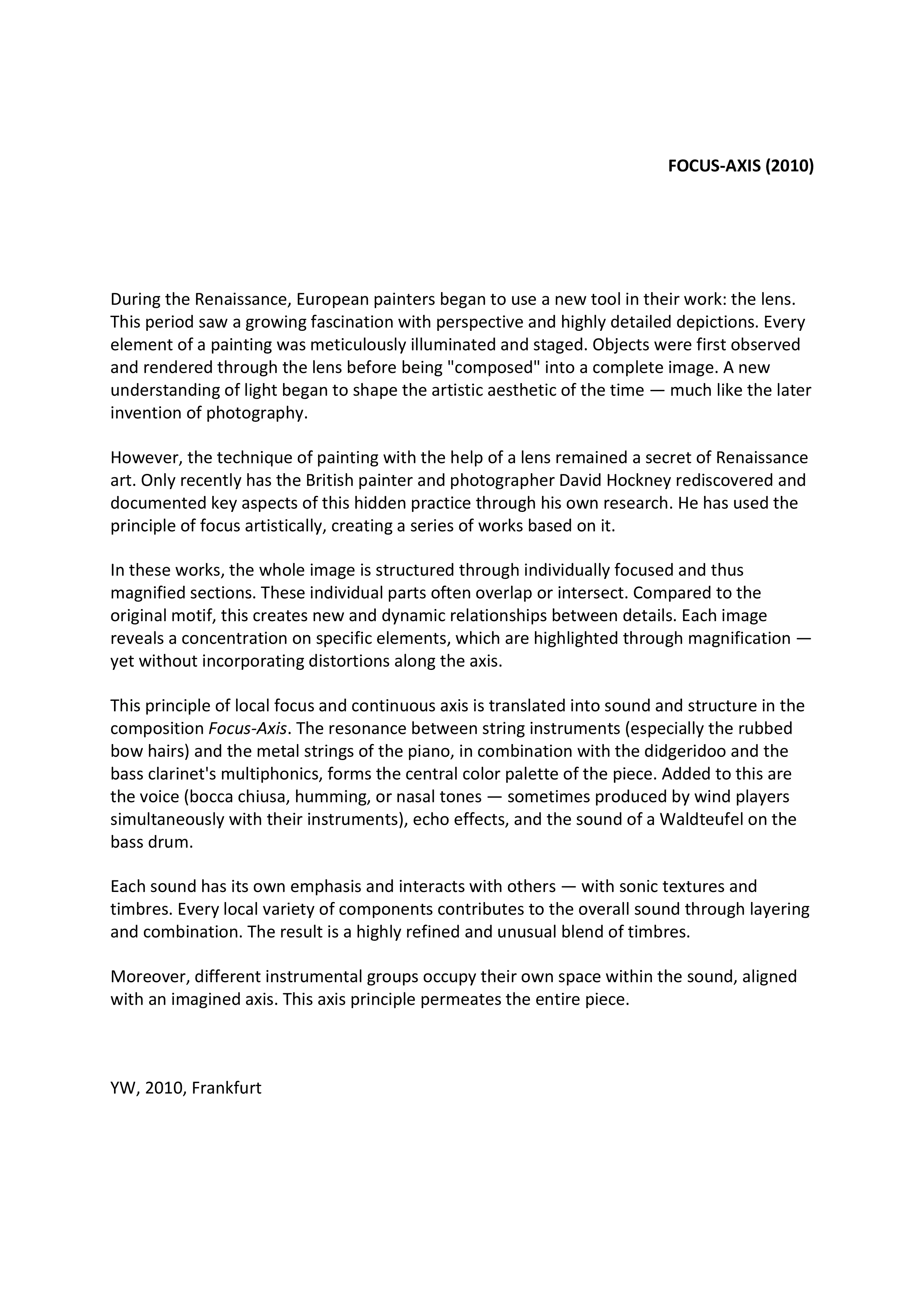
During the Renaissance, European painters began to use a new tool in their work: the lens.
This period saw a growing fascination with perspective and highly detailed depictions. Every
element of a painting was meticulously illuminated and staged. Objects were first observed
and rendered through the lens before being "composed" into a complete image. A new
understanding of light began to shape the artistic aesthetic of the time — much like the later
invention of photography.
However, the technique of painting with the help of a lens remained a secret of Renaissance
art. Only recently has the British painter and photographer David Hockney rediscovered and
documented key aspects of this hidden practice through his own research. He has used the
principle of focus artistically, creating a series of works based on it.
In these works, the whole image is structured through individually focused and thus
magnified sections. These individual parts often overlap or intersect. Compared to the
original motif, this creates new and dynamic relationships between details. Each image
reveals a concentration on specific elements, which are highlighted through magnification —
yet without incorporating distortions along the axis.
This principle of local focus and continuous axis is translated into sound and structure in the
composition Focus-Axis. The resonance between string instruments (especially the rubbed
bow hairs) and the metal strings of the piano, in combination with the didgeridoo and the
bass clarinet's multiphonics, forms the central color palette of the piece. Added to this are
the voice (bocca chiusa, humming, or nasal tones — sometimes produced by wind players
simultaneously with their instruments), echo effects, and the sound of a Waldteufel on the
bass drum.
Each sound has its own emphasis and interacts with others — with sonic textures and
timbres. Every local variety of components contributes to the overall sound through layering
and combination. The result is a highly refined and unusual blend of timbres.
Moreover, different instrumental groups occupy their own space within the sound, aligned
with an imagined axis. This axis principle permeates the entire piece.
YW, 2010, Frankfurt / www.yingwang.de
- Recording Notes
•26.09.2010, IEMA Ensemble,Conductor: Susanne Blumenthal
Hochschule für Musik und Darstellende Kunst, Frankfurt
• 02.10.2010, ZKM_Kubus
• 08.12.2015, Tokyo Sinfonietta,Conductor: Yasuaki Itakura
Tokyo Bunka Kaikan, Recital Hall
- Record Label
- IEMA
- Performer Credits
- internationalen ensemble modern akademie / IEMA Ensemble Conductor: Susanne Blumenthal
- Publisher
- IEMA
- External Links