1 / 18
0:00/0:00
Solo
2025
Piano
- Program Notes
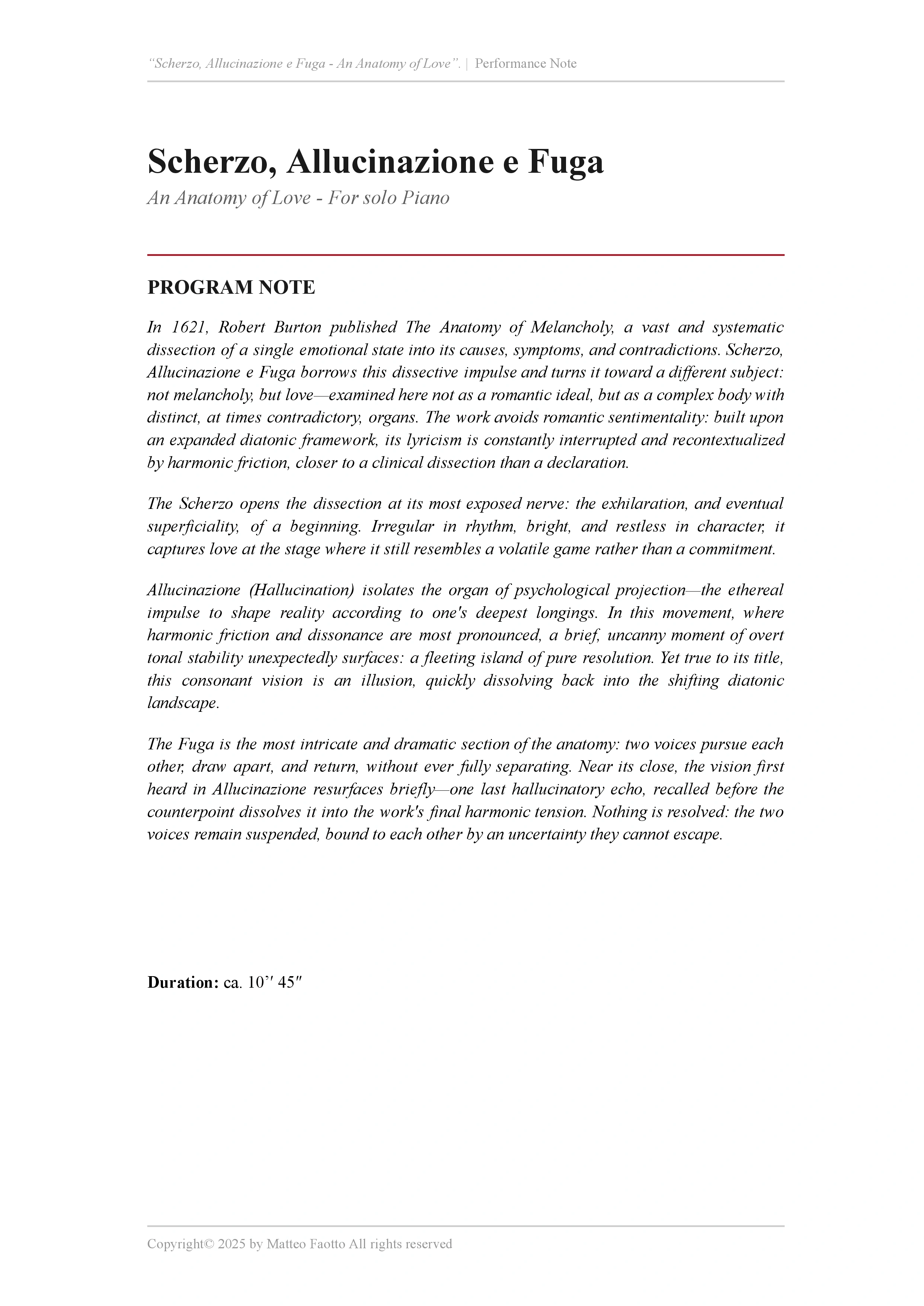
In 1621, Robert Burton published The Anatomy of Melancholy, a vast and systematic dissection of a single emotional state into its causes, symptoms, and contradictions. Scherzo, Allucinazione e Fuga borrows this dissective impulse and turns it toward a dif erent subject: not melancholy, but love—examined here not as a romantic ideal, but as a complex body with distinct, at times contradictory, organs.
The work avoids romantic sentimentality: built upon an expanded diatonic framework, its lyricism is constantly interrupted and recontextualized by harmonic friction, closer to a clinical dissection than a declaration.
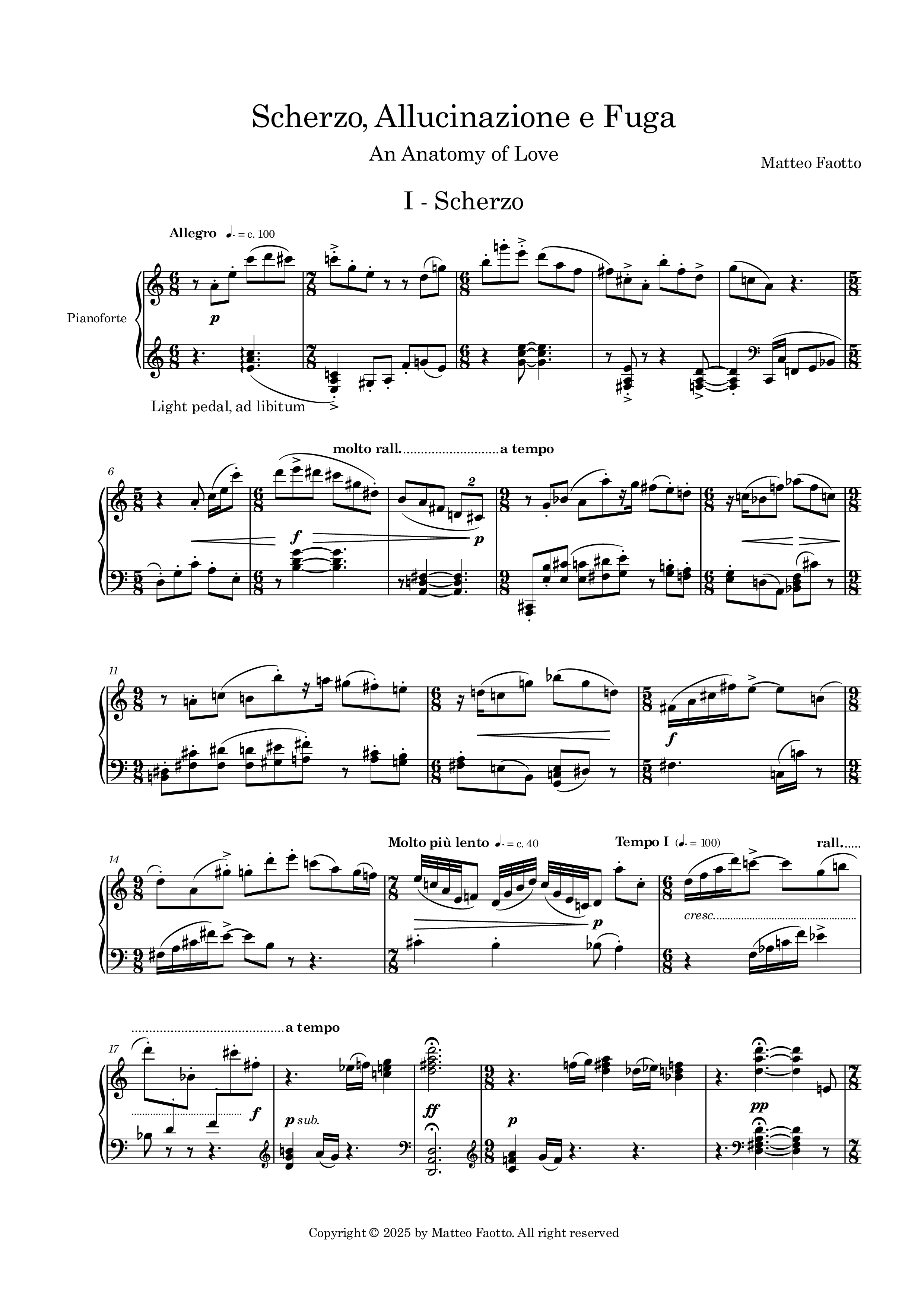
The Scherzo opens the dissection at its most exposed nerve: the exhilaration, and eventual superficiality, of a beginning. Irregular in rhythm, bright, and restless in character, it captures love at the stage where it still resembles a volatile game rather than a commitment.
Allucinazione (Hallucination) isolates the organ of psychological projection—the ethereal impulse to shape reality according to one's deepest longings. In this movement, where harmonic friction and dissonance are most pronounced, a brief, uncanny moment of overt tonal stability unexpectedly surfaces: a fleeting island of pure resolution. Yet true to its title, this consonant vision is an illusion, quickly dissolving back into the shifting diatonic landscape.
The Fuga is the most intricate and dramatic section of the anatomy: two voices pursue each other, draw apart, and return, without ever fully separating. Near its close, the vision first heard in Allucinazione resurfaces briefly—one last hallucinatory echo, recalled before the counterpoint dissolves it into the work's final harmonic tension. Nothing is resolved: the two voices remain suspended, bound to each other by an uncertainty they cannot escape.
- Recording Notes
Audio rendering and sound editing produced with NotePerformer 3 from a Steinberg Dorico score