1 / 32
0:00/0:00
Orchestra
2025
- Program Notes
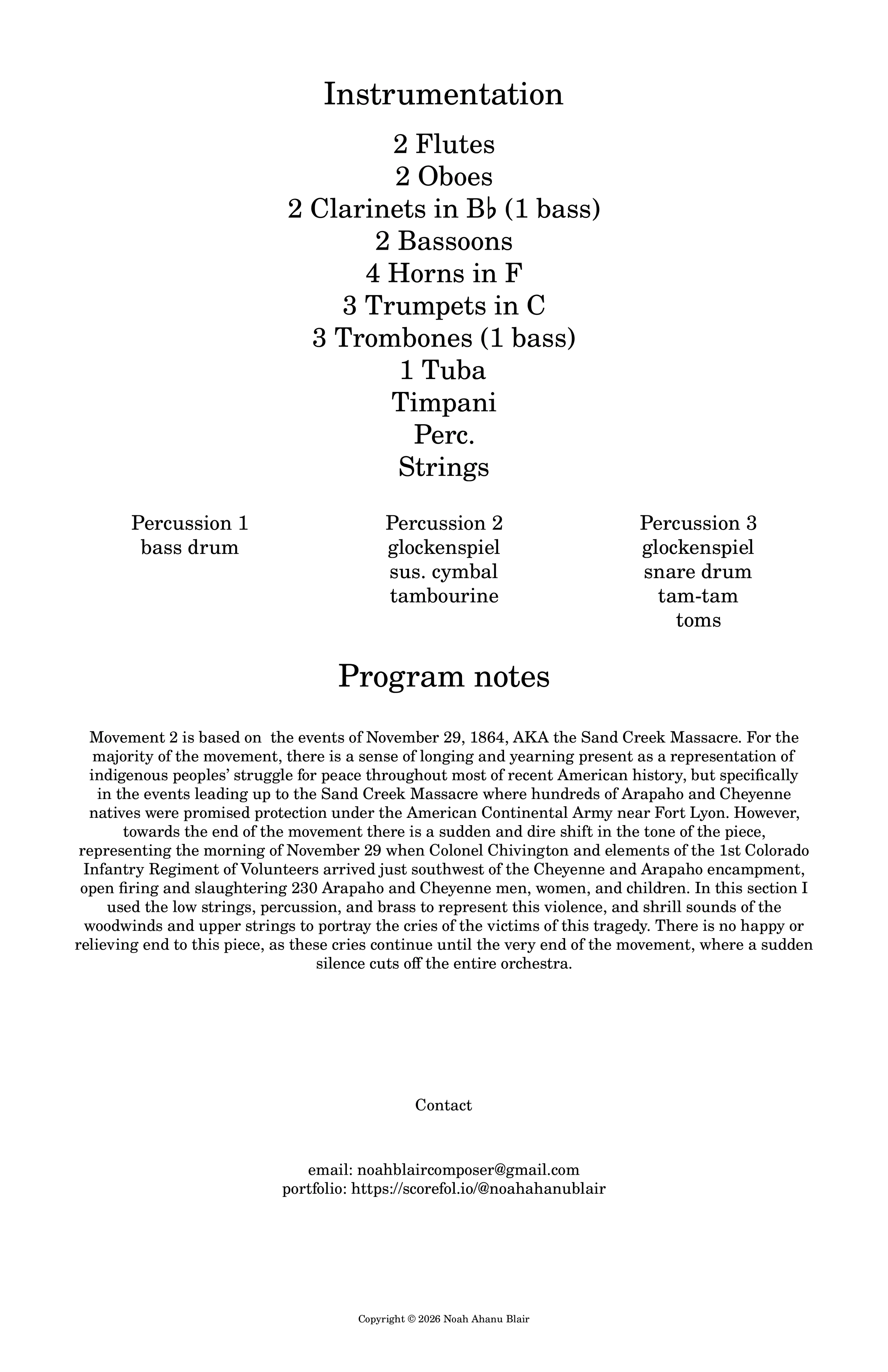
Movement 2 is based on the events of November 29, 1864, AKA the Sand Creek Massacre. For the majority of the movement, there is a sense of longing and yearning present as a representation of Indigenous peoples’ struggle for peace throughout most of recent American history, but specifically in the events leading up to the Sand Creek Massacre where hundreds of Arapaho and Cheyenne natives were promised protection under the American Continental Army near Fort Lyon. However, towards the end of the movement there is a sudden and dire shift in the tone of the piece, representing the morning of November 29 when Colonel Chivington and elements of the 1st Colorado Infantry Regiment of Volunteers arrived just southwest of the Cheyenne and Arapaho encampment, open fired on the native encampment, and slaughtered 230 Arapaho and Cheyenne men, women, and children. In this section I used the low strings, percussion, and brass to represent this violence, and shrill sounds of the woodwinds and upper strings to portray the cries of the victims of this tragedy. There is no happy or relieving end to this piece, as these cries continue until the very end of the movement, where a sudden silence cuts off the entire orchestra.