1 / 43
Duo
1994
Violin
- Program Notes
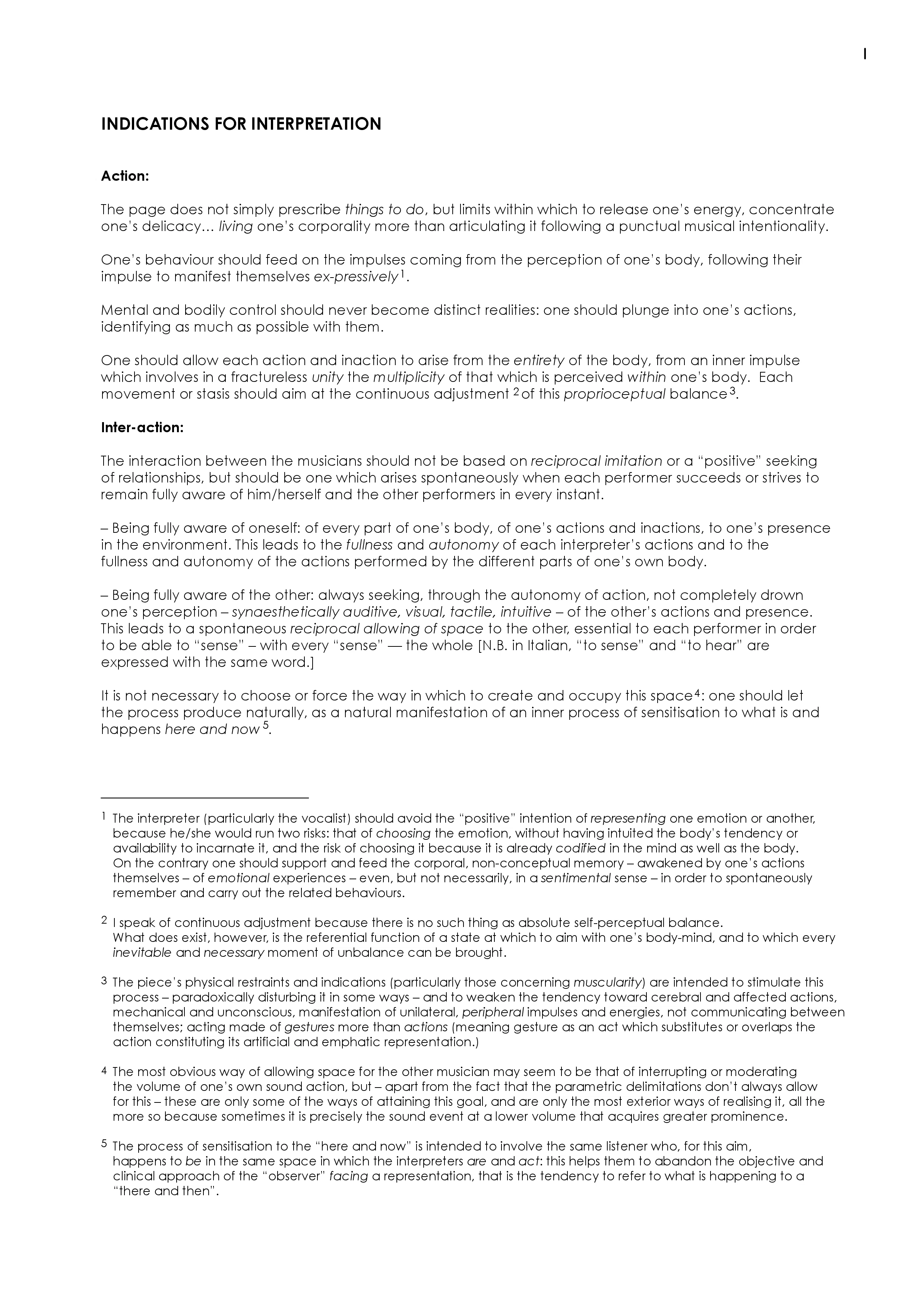
- The score traces a detailed web of physical constraints and experiential stimuli, which passes through the interpreter’s body and conditions its behaviour at different levels. Such indications – which range from the most macroscopic to the most subtle, such as the contraction and relaxation of parts of the body that are not obviously involved in the sound action – do not simply constitute a score of “things to do”, but rather the limits within which to discharge one's violence, to concentrate one's delicacy...: living one's own corporeality, more than articulating it according to a punctual musical intentionality The composition requires that the interpreter’s behaviour is fed by the impulses which come from their perception of their own body, and that the performer supports their natural drive to manifest. Feeding their corporeal memory – reawakened by their own beahaviour – of emotional sensations that are deeply concealed, the interpreter will spontaneously remember and actualise motor behaviours that are connected to them. This process should plunge into the here and now without the interpreter deciding or foreseeing what they will do moment by moment. Above all, one must avoid the attempt to musically represent or describe their own interior state, an attempt which will weaken their contact with themselves. Moreover the inter-action between the two interpreters shall not be based on reciprocal imitation or on a "positive" research for relations, but shall spring from their intense reciprocal experiential connection. When, in fact, the interpreter attempts not to suffocate their own perceptions (aural, visual, emotional) of all that happens and exists moment by moment, including the living presence of the audience, they manage to spontaneously create the space in which every thing breathes. Sensitisation to the present space and time is meant to involve the audience. To this end, what might be effective is that the musician does not perform on a stage but rather among the spectators. In this way, the audience will find itself in the same space as that in which the interpreter lives and performs. This is what will allow to more easily abandon an objective and clinical approach typical of an observer in front of a performance, in other words, the tendency to refer to a there and then what is happening here and now.
- Recording Notes
- Recorded live at Happy New Years Festival | Santa Marta Church, Ivrea (Italy) | 4 May 1994
- Performer Credits
- Marco Rogliano violinist, Renato Gatto vocalist
- External Links