
1 / 8
0:00/0:00
String Quartet
2023
Cello
Fixed Media Audio
Viola
Violin
- Program Notes
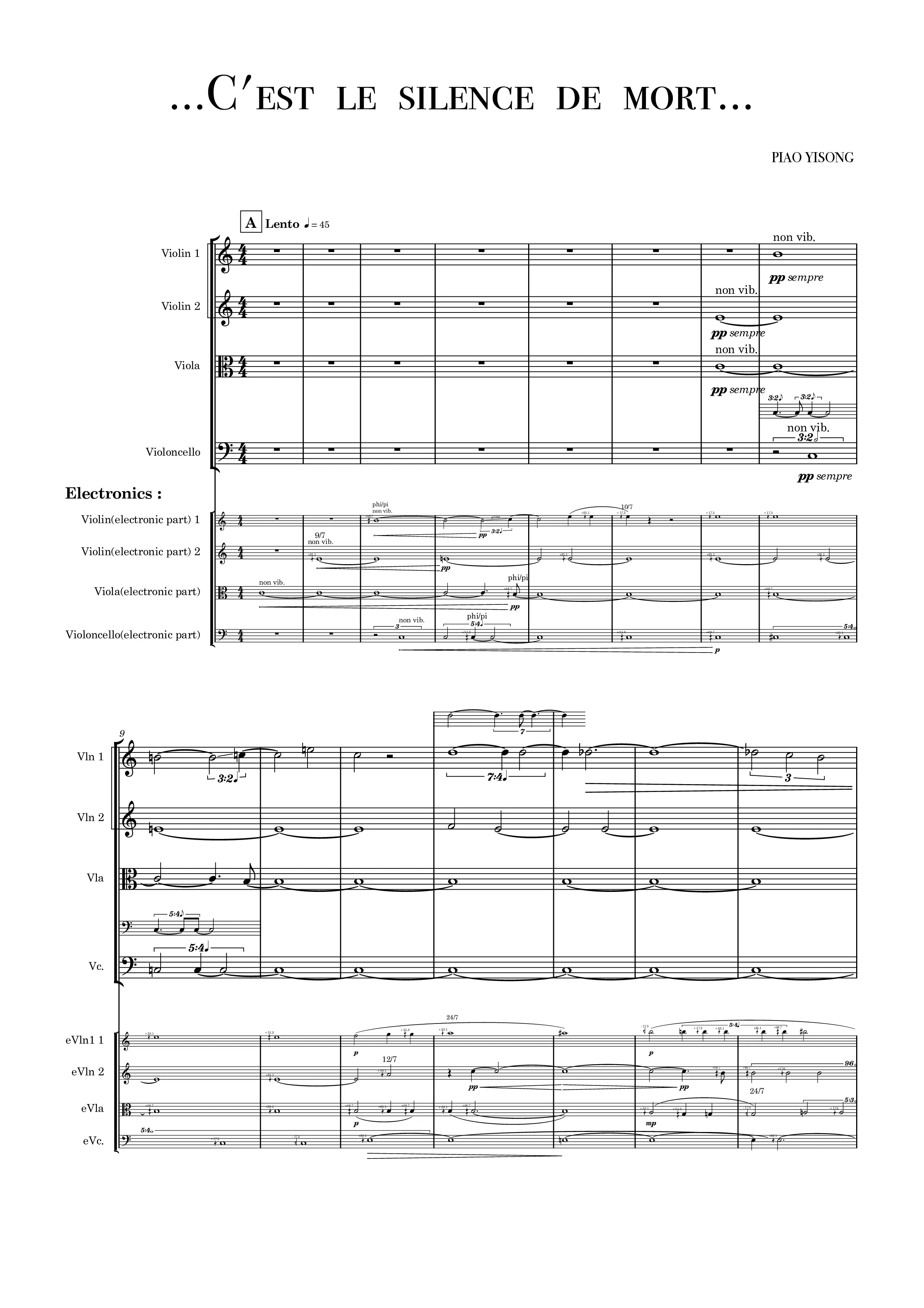
- The twelve-tone equal temperament system is both unfamiliar yet intimately known to me. Although it can be flawlessly realized within the realm of MIDI, I hold the belief that true twelve-tone equal temperament doesn't exist in any practical performance scenario—it exists merely as an ideal. Performers with complete command of technique and a discerning musical taste invariably infuse subtle nuances into their performances, consciously or subconsciously swayed by the innate human auditory instincts and personal aesthetic preferences. Throughout the extensive history of music, from early human rhythmic beatings in caves to today's cutting-edge compositions, we have persistently sought to explore and push boundaries in terms of texture and timbre. However, I remain steadfast in my belief that regardless of how music evolves, notes will forever be the most effective and emotionally compelling elements of musical expression. In the realm of twelve-tone equal temperament, I am intrigued by a less traditionally emphasized, yet increasingly explored domain—Microtonal music. I use this term as a representative, although its exact definition sparks considerable debate. Here is a brief introduction to the structure of this piece: it comprises three parts. The first part is built around pitches derived from the fundamental note C4—261.63hz in equal temperament (12 equal division of the octave, or 12-EDO), obtained through multiplication by a set of specific ratios (all the microtones are featured in the fixed media section, save for the very end of the piece). The second part employs the fundamental frequency of G4 (+82.492), which exceeds the G4 in 12-EDO by 82.492 cents, and multiplies it with a different set of chosen ratios. The third part is a recapitulation, weaving together the notes introduced in the previous sections. As the selected ratios are all based on a denominator of 7, the resulting fusion exceeds my initial expectations. The technique deployed is non-vibrato, accompanied by extensive use of the canon technique to approximate the envisioned effect. As for the instrumental part, I encourage performers to discover pitches that they find most comfortable to play, as this also aligns with the sonic effect I am hoping to achieve.
- Record Label
- A-HL
- Performer Credits
- *Temporary Modern Music Performance Group of HYU
- Publisher
- A-HL