1 / 26
0:00/0:00
Solo
2022
Trumpet
- Recording Notes
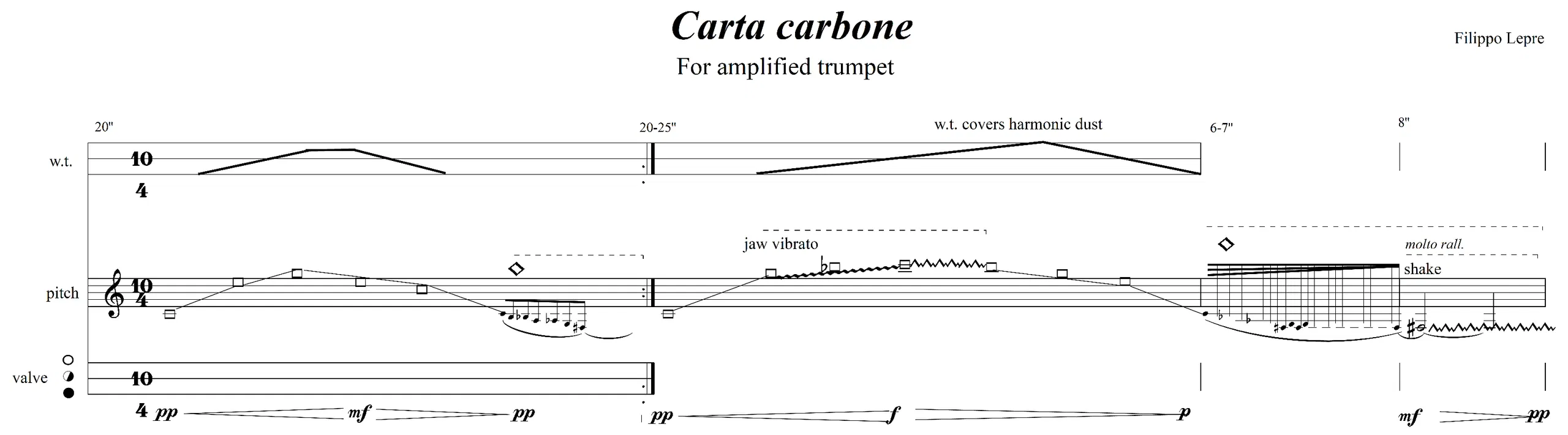
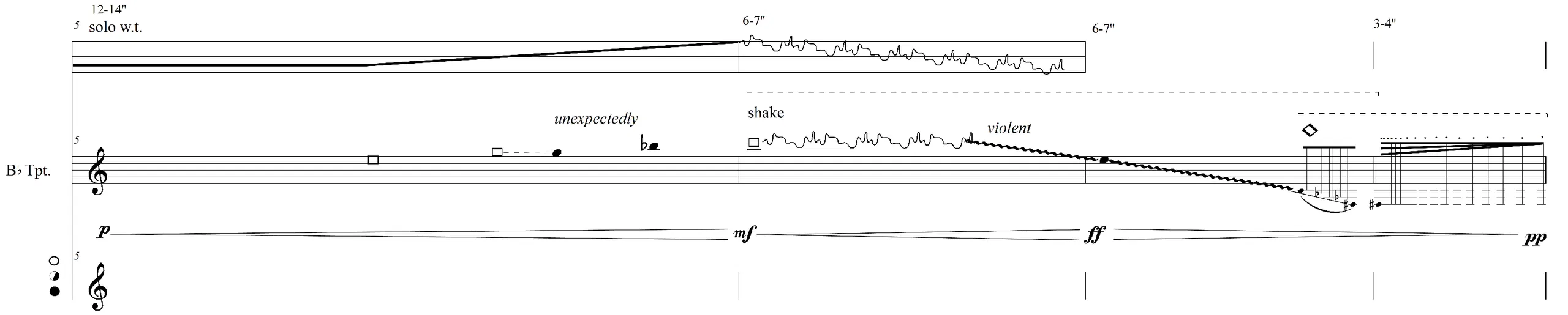
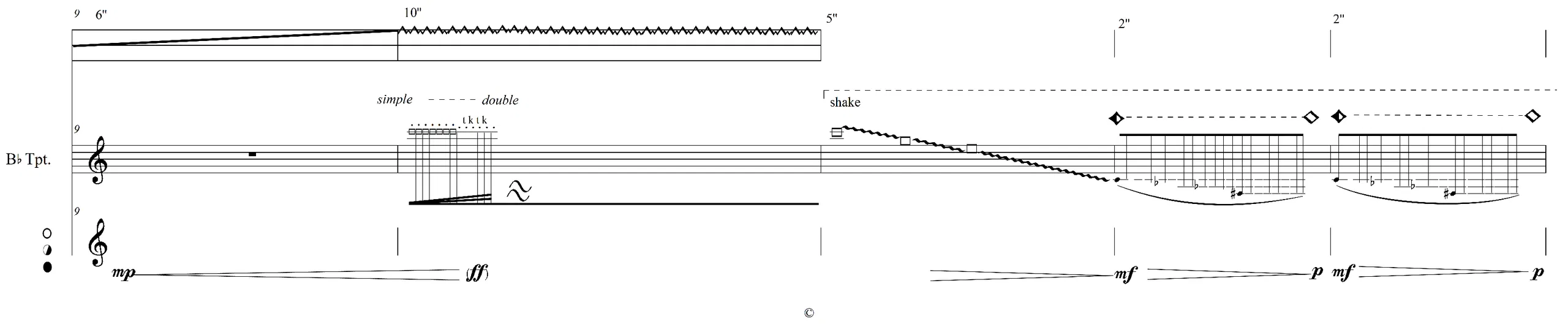
- Carta carbone is the result of an in-depth study of the trumpet, explored and proposed not in its cantabile and heroic peculiarities that I often associate with it, but rather in its more evanescent, more intangible sonorities, linked to unstable sounds, often very complex; in short, in its less trumpet-like sonority, whose feasibility is guaranteed since, being a trumpet player by training and having collaborated with a virtuoso of the instrument, Carta carbone was composed "with the instrument in hand." The workshop activity that accompanied the composition of this piece introduced me to new scenarios on brass instruments and served to focus even more on my interest in "action polyphony," that is, the simultaneous coexistence of several instrumental gestures, related or unrelated to each other. And so, in this sense, systems of one stave and two trigrams are noted in Carta carbone, where the upper trigram relates to whistle tones and the lower one to the degree of piston lowering. The management of these three levels of action opens controllable outcomes up to a certain point and raises questions about the hierarchy between these levels, about the possibility of having a syntax in which multiple planes of meaning join, fortify but also annihilate. The strong gestural identity that connotes Carta carbone is never to the detriment of the other degree of detail in the notation, although often the notation is open, creating a kind of antinomy between the need for prescription and the need for freedom. The desire not to use mutes, plungers and various gadgets, which in a trumpet piece would be a fairly obvious choice, responds to the desire to write a piece that aims to investigate an unconventional and little-explored sound condition to date in trumpet literature. Since the performing note is very laborious - since the techniques used are uncommon - a recording of the entire composition is attached to it, so that any doubts about the interpretation of certain notations can be safely answered by listening
- Performer Credits
- Simone Telandro