1 / 17
0:00/0:00
String Trio
2017
Cello
Viola
Violin
- Program Notes
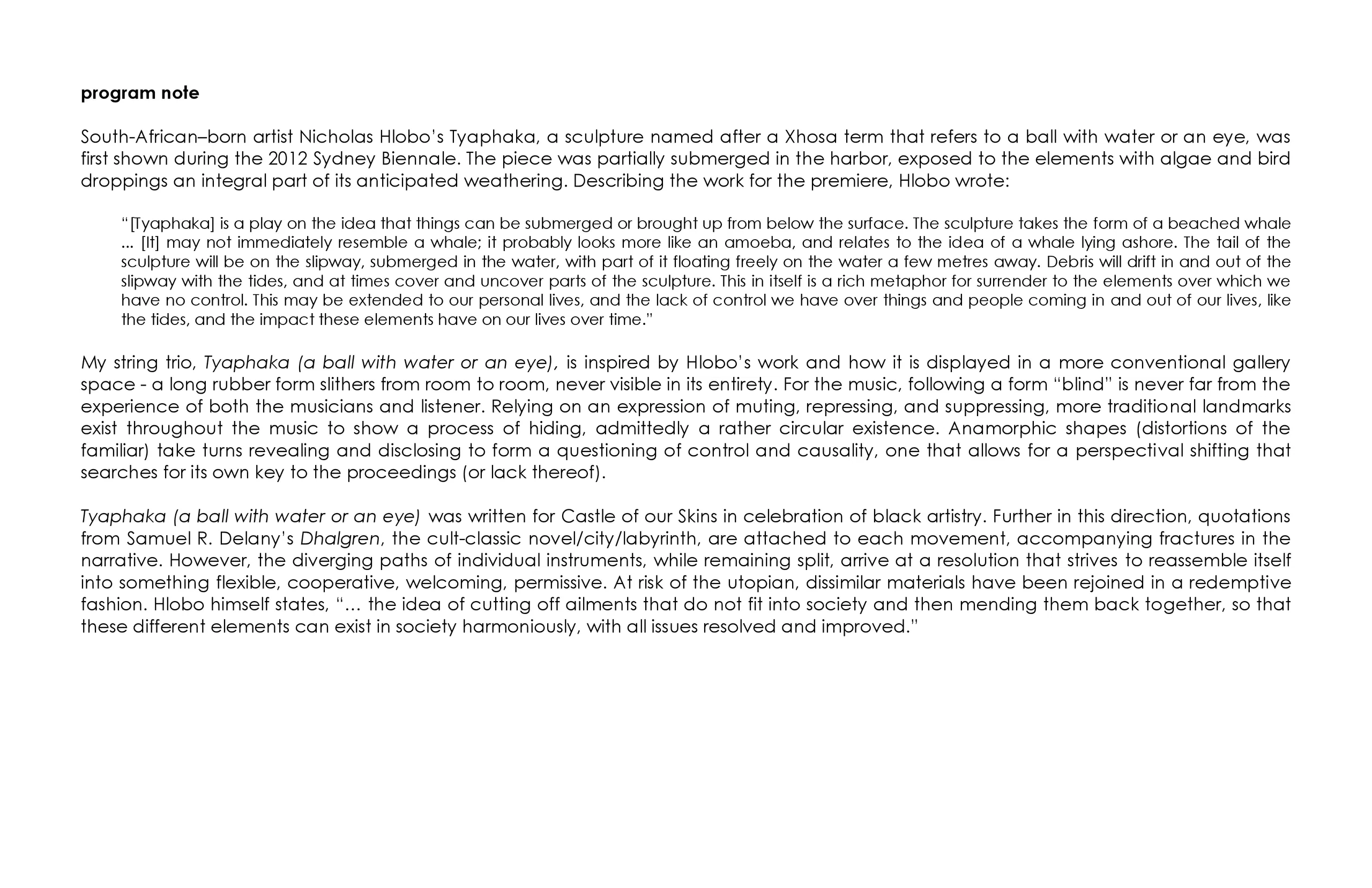
- South-African–born artist Nicholas Hlobo’s Tyaphaka, a sculpture named after a Xhosa term that refers to a ball with water or an eye, was first shown during the 2012 Sydney Biennale. The piece was partially submerged in the harbor, exposed to the elements with algae and bird droppings an integral part of its anticipated weathering. Describing the work for the premiere, Hlobo wrote: << [Tyaphaka] is a play on the idea that things can be submerged or brought up from below the surface. The sculpture takes the form of a beached whale ... [It] may not immediately resemble a whale; it probably looks more like an amoeba, and relates to the idea of a whale lying ashore. The tail of the sculpture will be on the slipway, submerged in the water, with part of it floating freely on the water a few metres away. Debris will drift in and out of the slipway with the tides, and at times cover and uncover parts of the sculpture. This in itself is a rich metaphor for surrender to the elements over which we have no control. This may be extended to our personal lives, and the lack of control we have over things and people coming in and out of our lives, like the tides, and the impact these elements have on our lives over time. >> Ingram's string trio, Tyaphaka (a ball with water or an eye), is inspired by Hlobo’s work and how it is displayed in a more conventional gallery space - a long rubber form slithers from room to room, never visible in its entirety. For the music, following a form “blind” is never far from the experience of both the musicians and listener. Relying on an expression of muting, repressing, and suppressing, more traditional landmarks exist throughout the music to show a process of hiding, admittedly a rather circular existence. Never far from the musical surface are quotations from a Paschalia (Courante) by 17th-century French baroque composer Jacques Champion de Chambonnières, meant to haunt the music as a reference to post-colonial issues surrounding contemporary concert music and dance traditions. Anamorphic shapes (distortions of these familiar baroque sounds) take turns revealing and disclosing to form a questioning of control and causality, one that allows for a perspectival shifting that searches for its own key (or lack thereof) to the music's probing and wandering atmosphere. Tyaphaka (a ball with water or an eye) was commissioned for the Boston-based Black arts institution Castle of our Skins in celebration of black artistry. The piece was originally written for string trio and choreographer/dancer, as well as a costume designer, and the premiere involved movement and interaction by musicians with the dancer. Further in this celebratory direction of black artistry, quotations from Samuel R. Delany’s Dhalgren, the cult-classic labyrinthine novel, are attached to each of the four movements (imagined as different rooms or floors of a house) in the score, accompanying the fractures in the musical narrative. However, the diverging paths of individual instruments, while remaining split, arrive at a resolution that strives to reassemble itself into something flexible, cooperative, welcoming, permissive. At risk of a utopian desire, dissimilar materials have been rejoined in a redemptive fashion. Hlobo himself states, “... the idea of cutting off ailments that do not fit into society and then mending them back together, so that these different elements can exist in society harmoniously, with all issues resolved and improved.”
- Recording Notes
- This is a live recording from Equilibrium Concert Series' (Boston MA, now a defunct organization) final concert on November 10, 2019. ~~ program details ~~ EQUILIBRIUM CONCERT SERIES Sunday, November 10, 2019 3:00 PM New School of Music, 25 Lowell Street, Cambridge Works by Michelle Lou (Porcupine), André Mestre (Corpo Confesso), and Clifton Ingram (Tyaphaka), as well as a world premiere of Silente (Étude Oblique IIIc) for solo cello by Pedro Alvarez \\ NOTE -- Two other performances exist for this piece online as videos, the premiere by Castle of our Skins and a second performance by New Gallery Concert Series, both featuring black dancers (Lexy Lattimore and Ramiro Vaughan Purpose, respectively) as a required for performance. Links to both have been provided in the External Links section, as well as a brief introduction video by the composer.
- Performer Credits
- Equilibrium Ensemble -- Lilit Hartunian (violin), Sam Kelder (viola), Stephen Marotto (cello)
- Publisher
- adret | ubac (self-published)
- External Links