- Program Notes
- Kids love storytime. It invites them to a completely new world in which anything can happen, even something beyond their imagination. In that world, they become new beings, which don't necessarily have to be anthropic (actually, it is very common that they become non‐human beings, e.g., frogs, rabbits, butterflies, whales, rainbow fish, unicorns, and even cars or gloves), and experience a sequence/timeline of a story deployed in a fantasied space and dimension.
While attending a storytime at a public library with my 5 years old little one, the idea came to me: writing a storytime; in this case it is not about a story unfolding on a timeline, but it is about the time unfolding in the storyline. Since music is the closest medium to the nature of time (physically, the definition of pitch is the times of oscillation in a unit time, and rhythm is the time), I wanted to write a piece about time, and invite the audience to experience being the time and join the journey of time. As I inhabited this new cosmic carnival/metaphysical amusement park, I realized that there were so many construction materials with which to design this time‐land architecture, because all music is somewhat about time, and time is the heart of music.
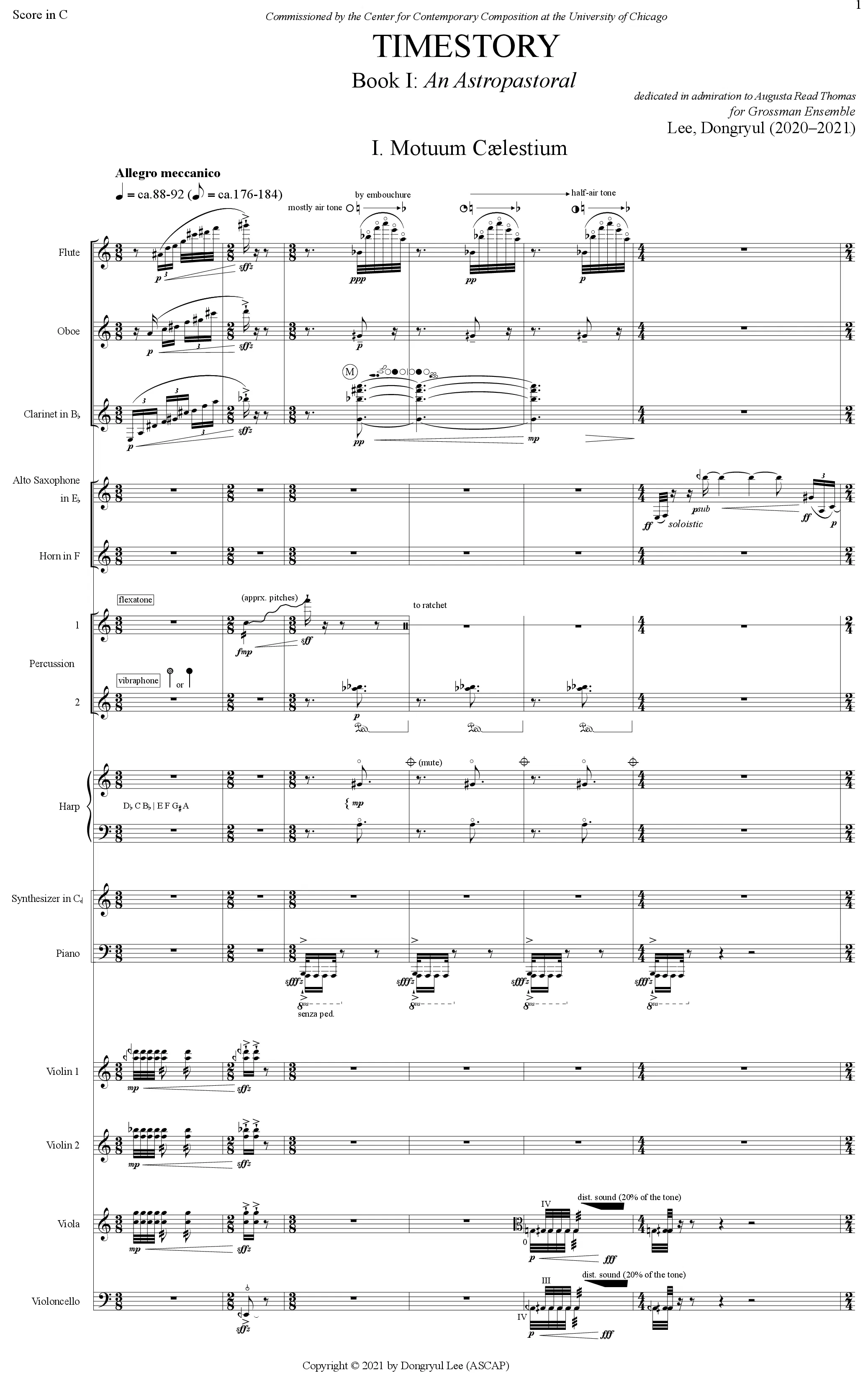
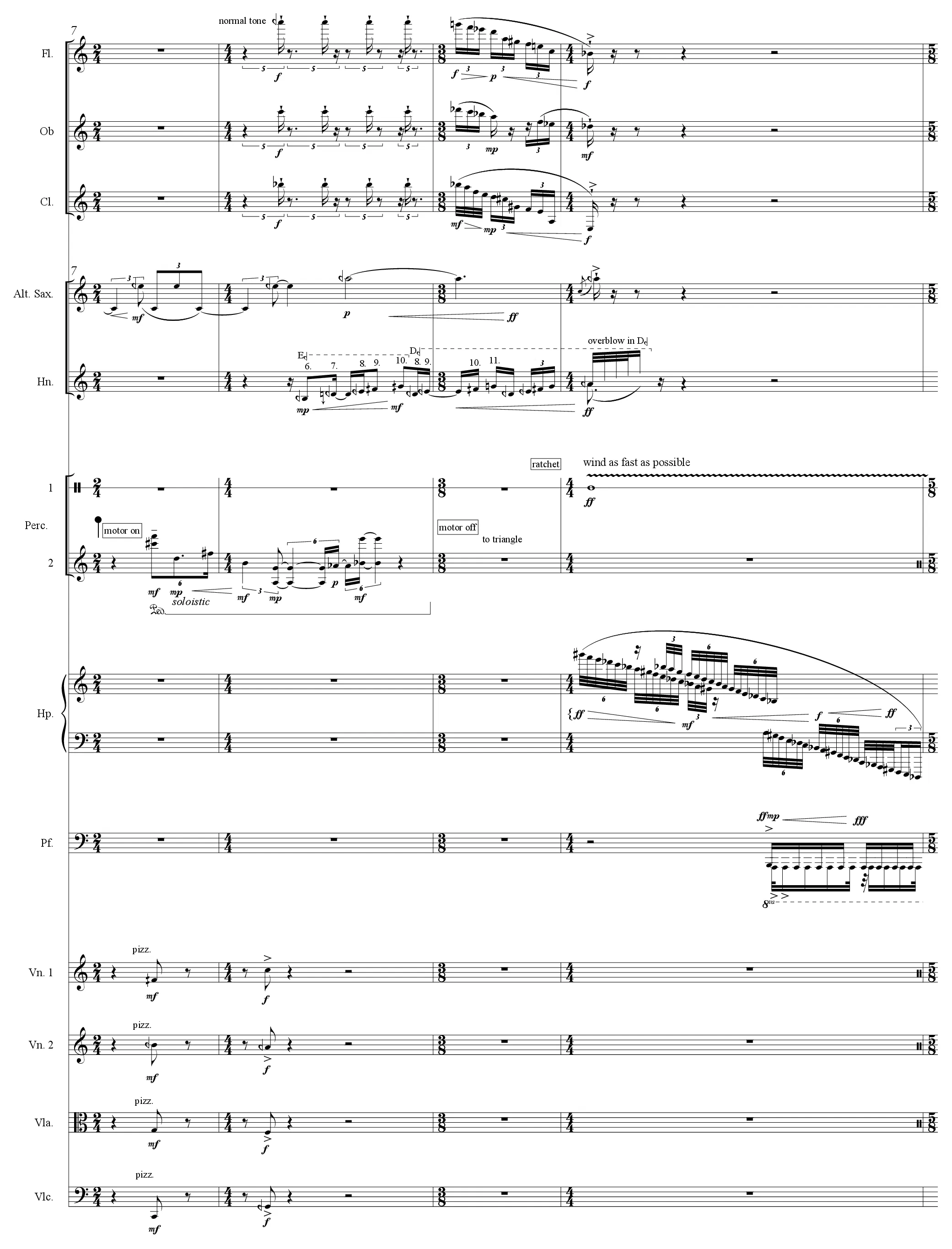
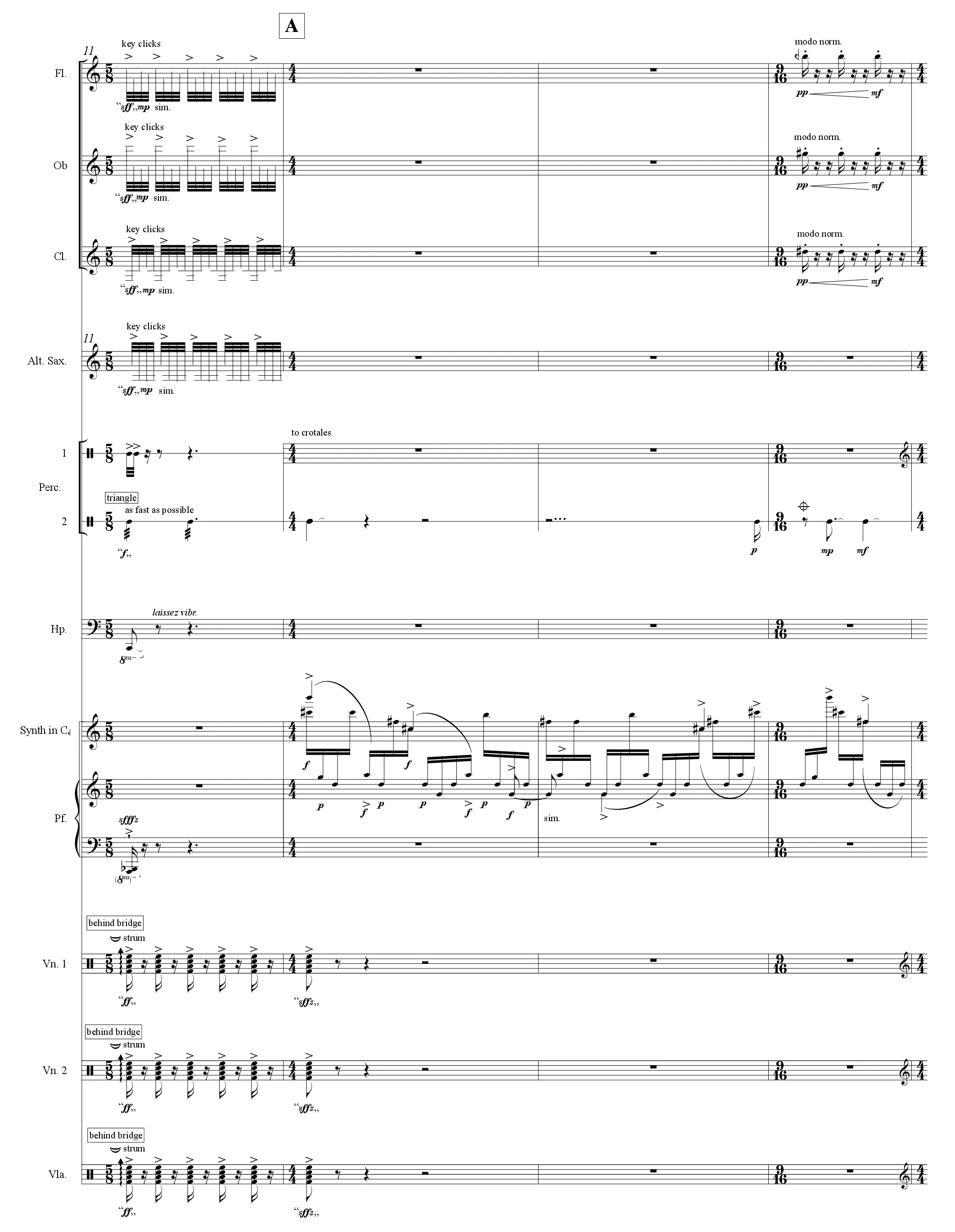
The first book of TIMESTORY is about stars, bells, movements, time, and their allegories, as the subtitle, An Astropastoral, suggests. The bell material builds upon my doctoral dissertation research. It uses the spectral data from the acoustical models of bell sounds and the modelling of virtual bell shapes by synthesizing engineering physics and campanology, using the Finite Element Method (FEM) technique. Note that the bell has always been the time keeper in our history, as the linguistic origin of “clock” is from the medieval Latin word “clocca,” which means bell. In this movement, there are multiple epiphanic moments when the clockwork sequence stops, and the ensemble becomes a gigantic bell/bell‐ecology. In the bell‐space there are multiple temporal and spatial layers, where various time‐beings are living and singing. The second movement is a passacaglia, which is interrupted twice by static episodes built upon a strong descending force. Here the falling stars/dying time metaphor is not about the morbid fear of death, but is about the beauty of the eternal return, the gravity of time.
The subtitle of first movement is from Newton’s book, PRINCIPIA: “Gravitas ergo non erit occulta causa motuum cælestium; siquidem ex phaenomenis ostensum est, hanc virtutem revera existere,” which can be translated as “The gravity of the cause of the motions of the celestial things, therefore, is not an occult; Indeed, the phenomenon has been shown that this force actually exists.”
- Recording Notes
- The performance was given by the Grossman Ensemble, conducted by Vimbayi Kaziboni at the Reva and David Logan Center for the Arts, Chicago, on December 3 2021
Live recording from the world premiere
- Performer Credits
- Grossman Ensemble
- Publisher
- NA