1 / 13
0:00/0:00
Duo
2022
Saxophone
- Program Notes
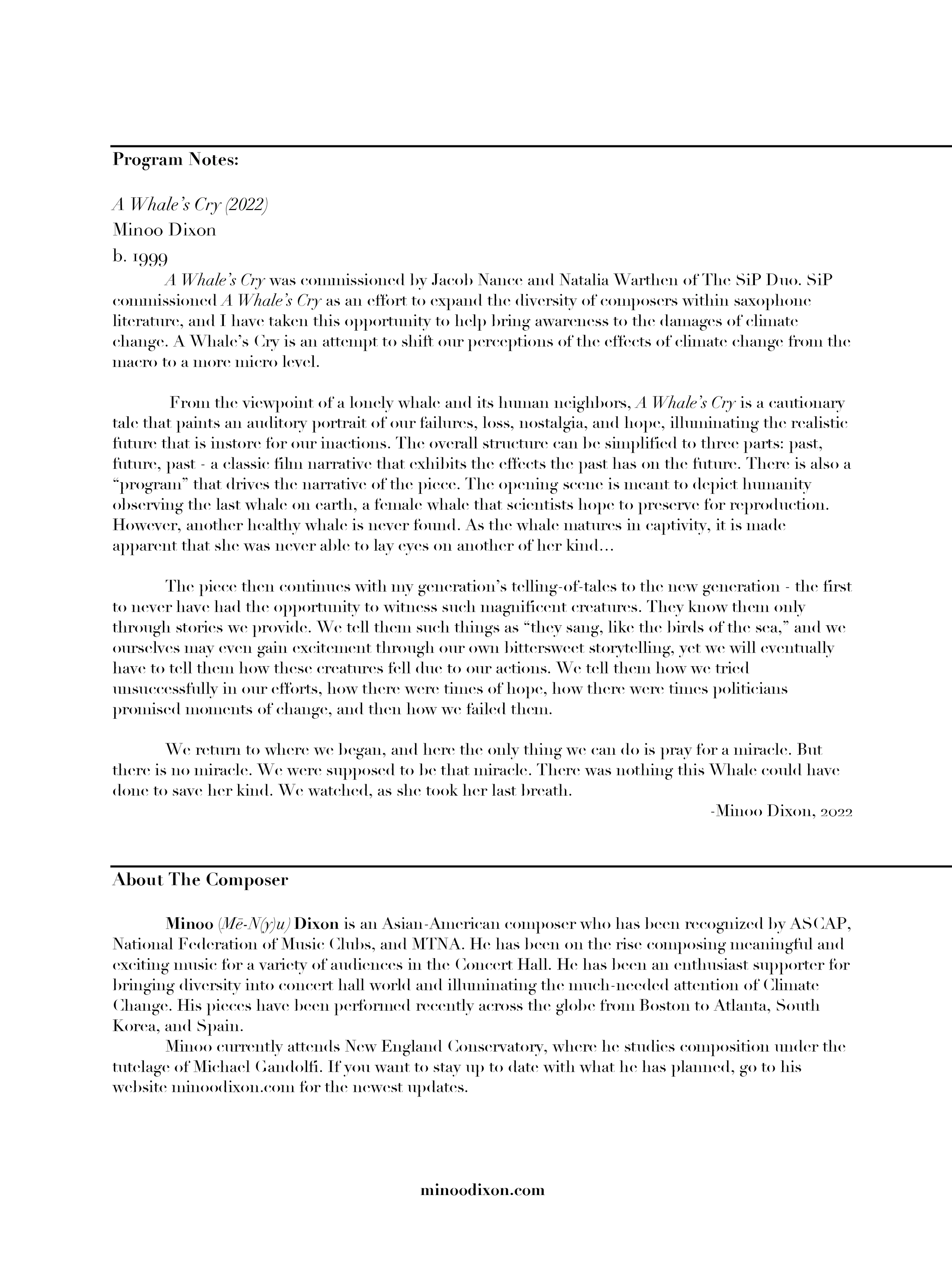
A Whale’s Cry was commissioned by Jacob Nance and Natalia Warthen of The SiP Duo. SiP commissioned A Whale’s Cry as an effort to expand the diversity of composers within saxophone literature, and I have taken this opportunity to help bring awareness to the damages of climate change. A Whale’s Cry is an attempt to shift our perceptions of the effects of climate change from the macro to a more micro level.
From the viewpoint of a lonely whale and its human neighbors, A Whale’s Cry is a cautionary tale that paints an auditory portrait of our failures, loss, nostalgia, and hope, illuminating the realistic future that is instore for our inactions. The overall structure can be simplified to three parts: past, future, past - a classic film narrative that exhibits the effects the past has on the future. There is also a “program” that drives the narrative of the piece. The opening scene is meant to depict humanity observing the last whale on earth, a female whale that scientists hope to preserve for reproduction. However, another healthy whale is never found. As the whale matures in captivity, it is made apparent that she was never able to lay eyes on another of her kind...
The piece then continues with my generation’s telling-of-tales to the new generation - the first to never have had the opportunity to witness such magnificent creatures. They know them only through stories we provide. We tell them such things as “they sang, like the birds of the sea,” and we ourselves may even gain excitement through our own bittersweet storytelling, yet we will eventually have to tell them how these creatures fell due to our actions. We tell them how we tried unsuccessfully in our efforts, how there were times of hope, how there were times politicians promised moments of change, and then how we failed them.
We return to where we began, and here the only thing we can do is pray for a miracle. But there is no miracle. We were supposed to be that miracle. There was nothing this Whale could have done to save her kind. We watched, as she took her last breath.
-Minoo Dixon, 2022
- Performer Credits
- SiP Duo (Jacob Nance and Natalia Warthen)
- Publisher
- Self Published