1 / 61
0:00/0:00
Quintet
2025
Flute
Piano
- Program Notes
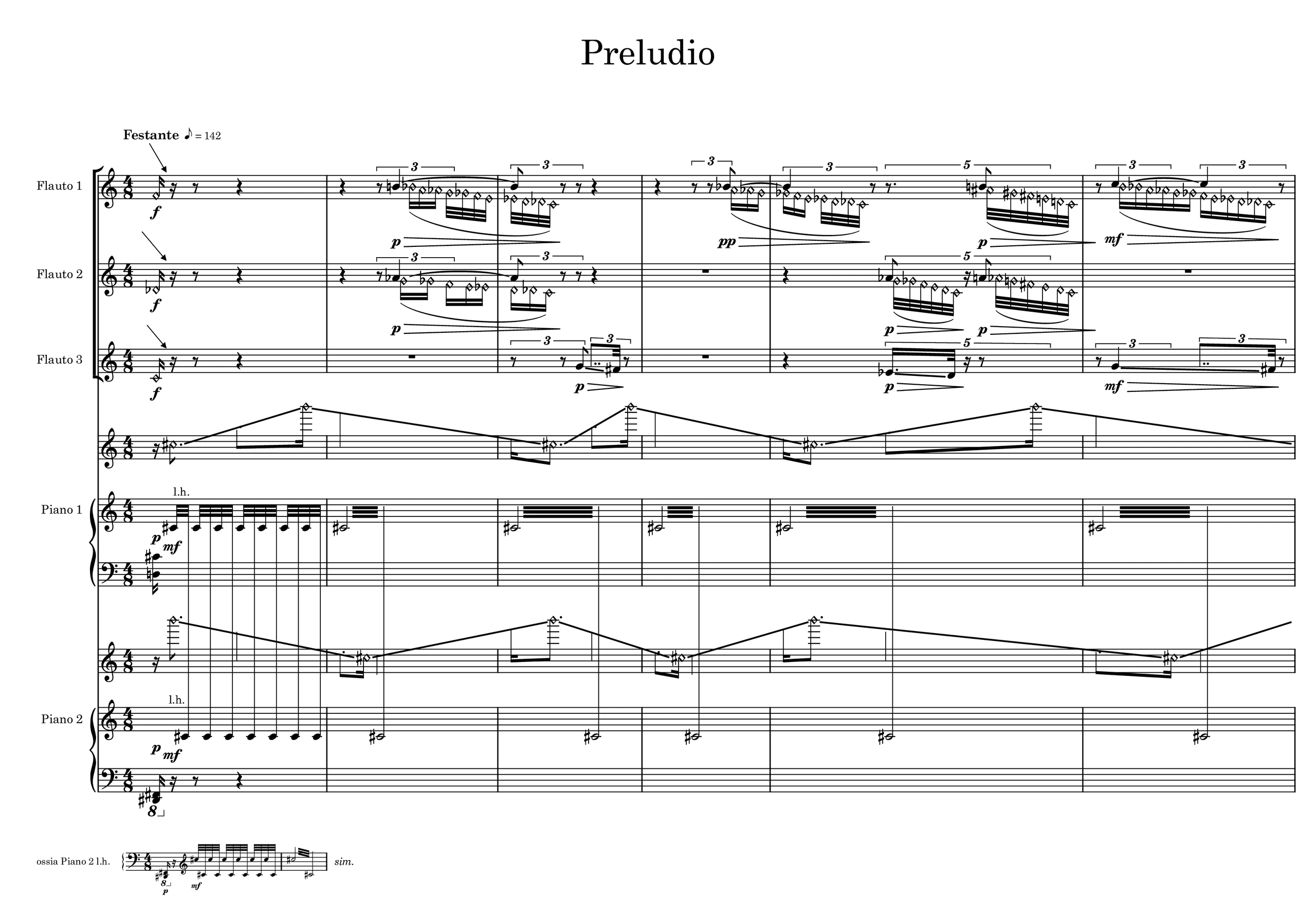
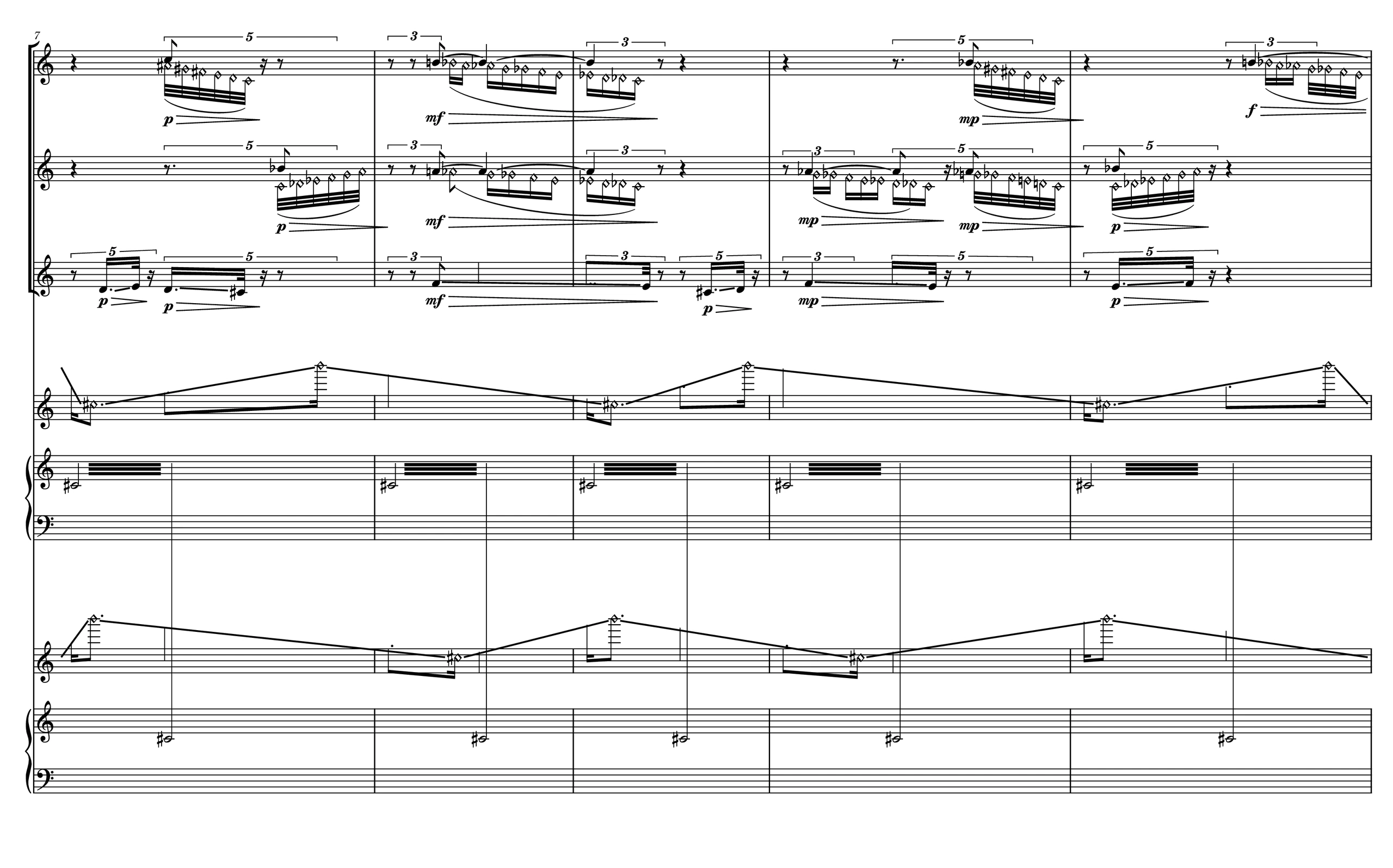
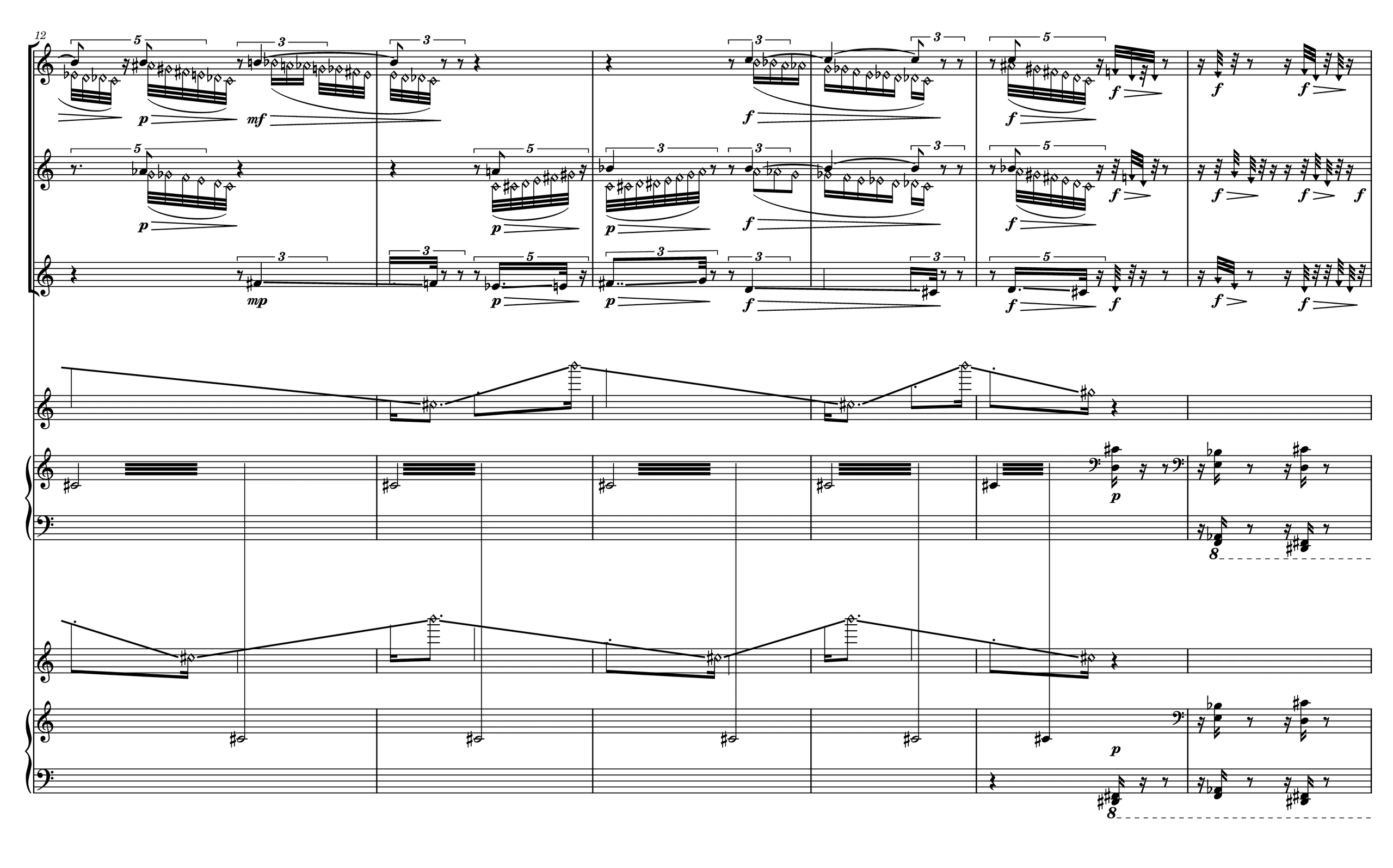
This piece was written for a specific occasion, and the particular choice of the ensemble thus arose primarily from the availability of the musicians present at the concert. Nevertheless, the organic seemed to me from the start to be particularly stimulating, as it clearly presents two homogeneous sound masses completely distinct from each other, each with extremely different timbral characteristics and possibilities. This allowed me first of all to obtain unusual sonorities for a chamber ensemble, using orchestral-style doublings, but extrapolated and laid bare in a chamber music context.
Secondly, having several instances of the same instrument makes it possible to create an infinity of dialogues, interlacements, alternations, which do not remain just coloristic effects but become structural elements of the development of the piece. The main source of inspiration for this kind of technique, although not exclusive to this piece, but which certainly could be here developed in all its possibilities, is Mozart's sonata for two pianos, where precisely a series of very fine interlacements, doublings and echo effects are used.
The form of this piece is composed of sections that merge, contaminate each other and return in an irregular way, inscribed in a simpler, almost classical overarching structure. First of all, the three-movement form stems from a desire to break out of the logic of the open form in a single movement so prevalent in contemporary music but also explored by myself in many of my earlier pieces.
Each movement then develops, as already anticipated, according to a rather simple macrostructure. The first movement presents an exposition, which, looking back, I can say is strongly reminiscent of that of a classical sonata, with two thematic groups and a coda. This first section is then simply repeated, keeping its structure practically unchanged, but inverting all the elements from which it is composed, what was loud, violent is now spoken sotto voce, is rapid and elusive, what was played by the flutes is now found on the pianos and vice versa, reversing the roles between the two groups of instruments, with seemingly incompatible possibilities, and in this way leading to a transfiguration of the material. The movement then closes unceremoniously and rather abruptly at the end of this re-exposition, without further addition of material, in a simple manner.
The second movement is the opposite of the first, in that it has no defined sections but a linear development, supported, however, by an ostinato, a low cluster played alternately by the two pianos, present for the entire duration of the movement. Here it is the alternation and irregular return of elements that constitutes the form. Brief thematic cells anticipate the material of the third movement, which is rapid and brief, based on a ternary form A B A, but which is made asymmetrical by the disproportion between the size of the opening section and the final section, which is almost a fleeting summary of the former. Almost a toccata, the first section of the movement is based on a single, very short thematic cell, which bounces, among the various instruments, transfigurating, as if through colored lenses. A new colorful figure, based on the parallel movement of major thirds dominates the second section, before the return, in passing, of the initial figure. A very short coda recapitulating the two main thematic elements closes the movement
- Recording Notes
Recorded in the Carl Orff Auditorium of the Hochschule für Musik und Theater München.
17/02/2026
Sound Engineer: Yannick Lunkenheimer
- Performer Credits
- Aleksandr Tian - Flute Angelina Kononova - Flute Amadeus Rotbart - Flute Chiung-Wen Hsu - Piano Minami Maehara - Piano Telmo Sans Ruiz - Conductor