- Program Notes
- ...A faint low marimba sounds seep out of the silence. Rather than musical tones with a clear pitch emanating from the marimba, it sounds to me like the result of a "translation" of a sensation or state of affairs difficult to grasp with the five senses, like "stagnant air," into a single, contextless acoustic phenomenon.
When I was commissioned to compose this piece for Marimba solo and percussion ensemble, my first thought was to begin by taking as much time as possible to present and explore this truly unique, yet rarely spotlighted, sonority of the marimba at the beginning of the piece. At the same time, I felt that this would result in something different in style from the virtuosic music that sweeps freely across a wide range of tones.
Another perspective is the percussion ensemble that serves as a background for the marimba in this piece. The sight of a large number of diverse percussion instruments lined up on stage, as is often seen in percussion ensembles (or multi-percussion), creates the visual impact (even before the performance begins). However, when I see these percussion instruments being struck one after the other in such a dizzying succession within a work, I am sometimes overcome with the feeling that it is difficult to grasp the presence of each individual instrument. Then the question arose in my mind: what if these percussion instruments existed in a way that was not necessarily directly touched or played by the performers' hands?
The work consists of two sections performed seamlessly.
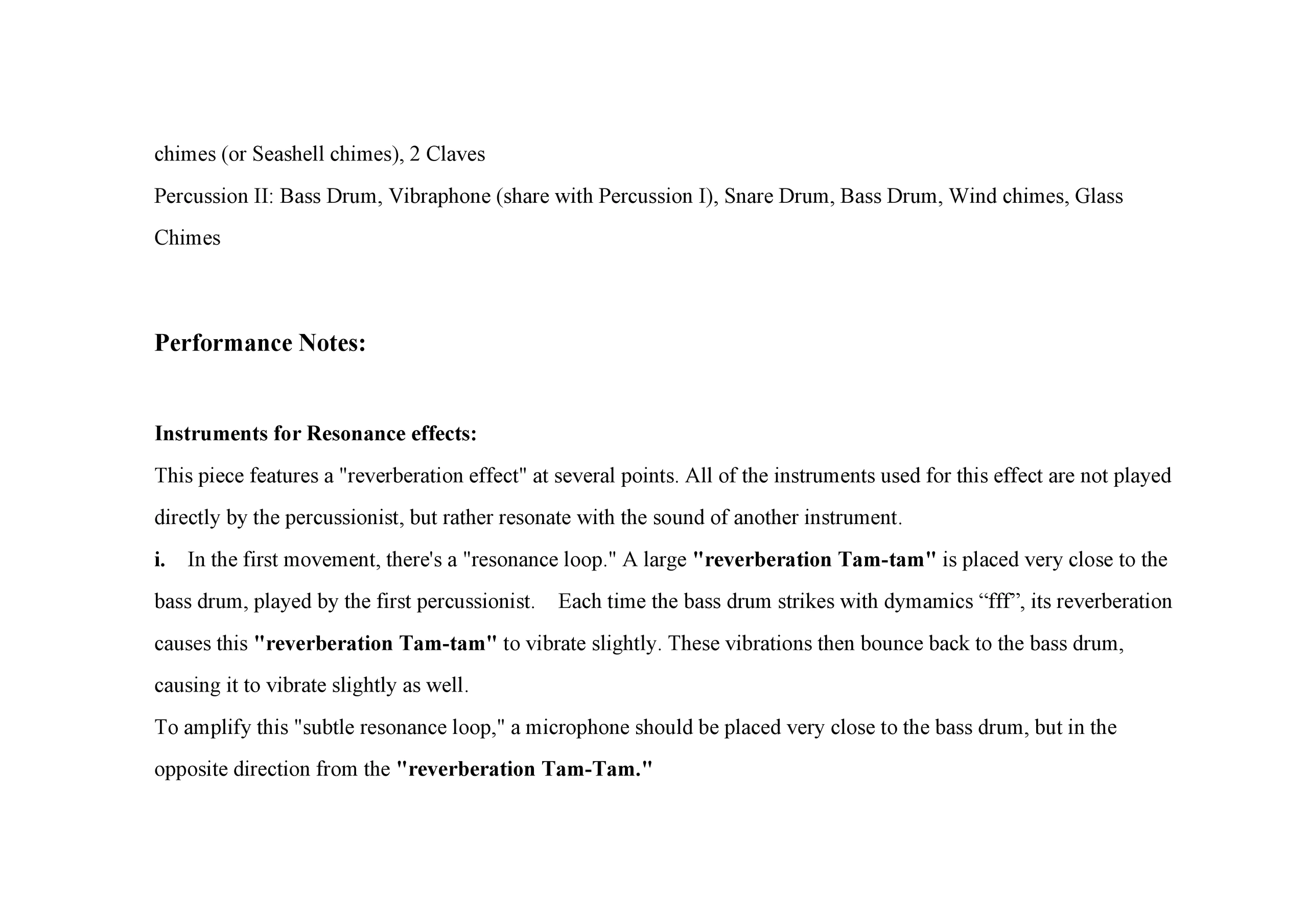
The first section begins with the faint, murky bass notes of a marimba. Eventually, the simple, clear strikes of a bass drum are heard repeatedly. Placed nearby is a large Tam-tam, which vibrates (resonates) faintly but clearly in response to the strikes. These vibrations then bounce back to the bass drum, causing it to vibrate again, creating a sort of "resonance loop". The marimba, outside of this complex, dissonant "resonance loop" of low frequencies, gradually ascends in range, establishing a clear harmony.
In the following second section, the marimba, which in the first section was outside the "resonance loop", now resonates with the wire of the snare drum, which is placed right in front of it.
Furthermore, the mallets, which are inserted as "objects" in the gaps between the tone plates throughout the marimba's high range, vibrate slightly on the tone plates when playing in that range, creating a hard noise.
These faint resonances combine with similar sounds from other instruments, gradually permeating the entire ensemble.
- Performer Credits
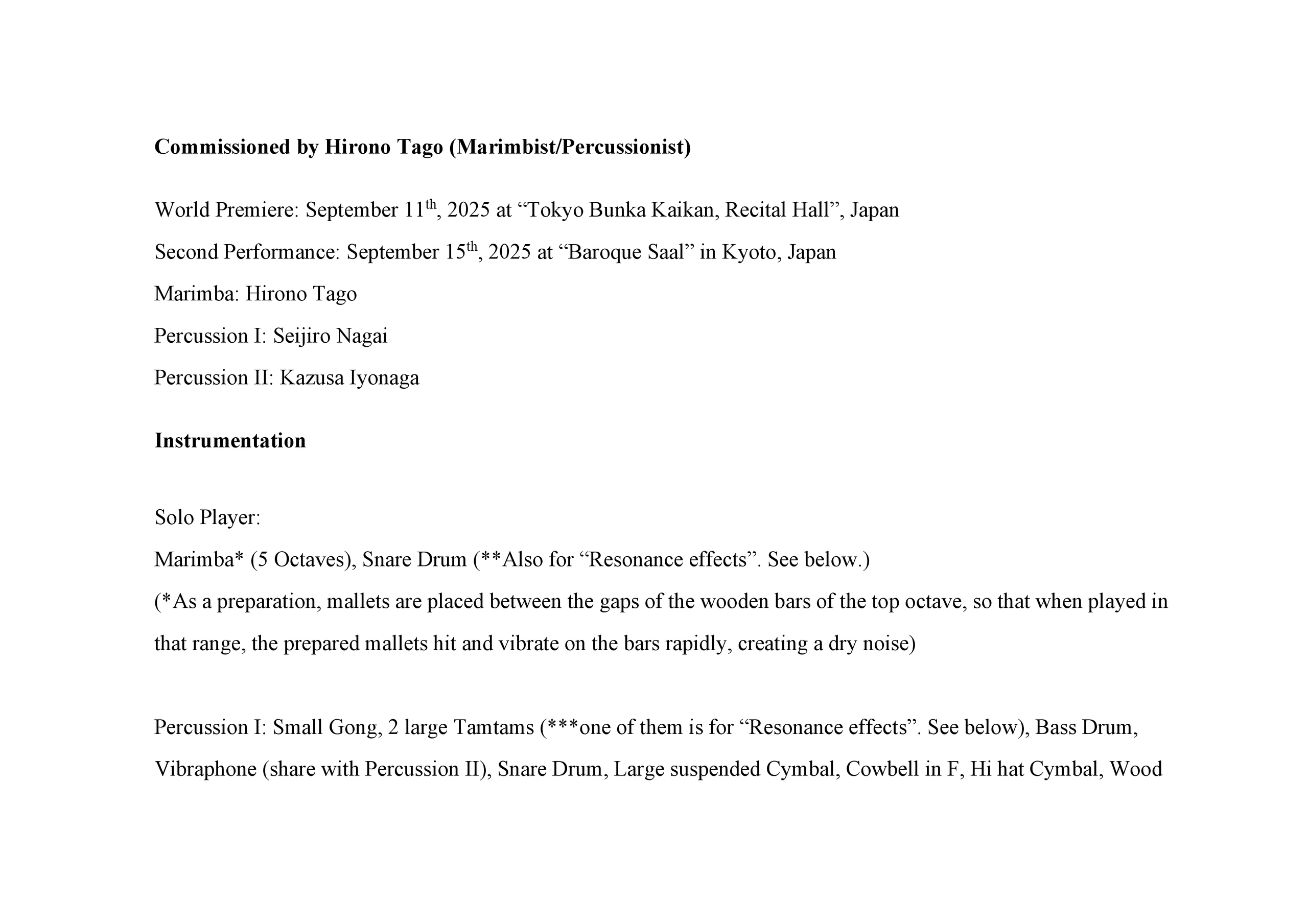
- Marimba: Hirono Tago, Percussion I: Seijiro Nagai, Percussion II: Kazusa Iyonaga