1 / 46
Wind Quintet
2025
Bassoon
Clarinet
Flute
Horn
Oboe
- Program Notes
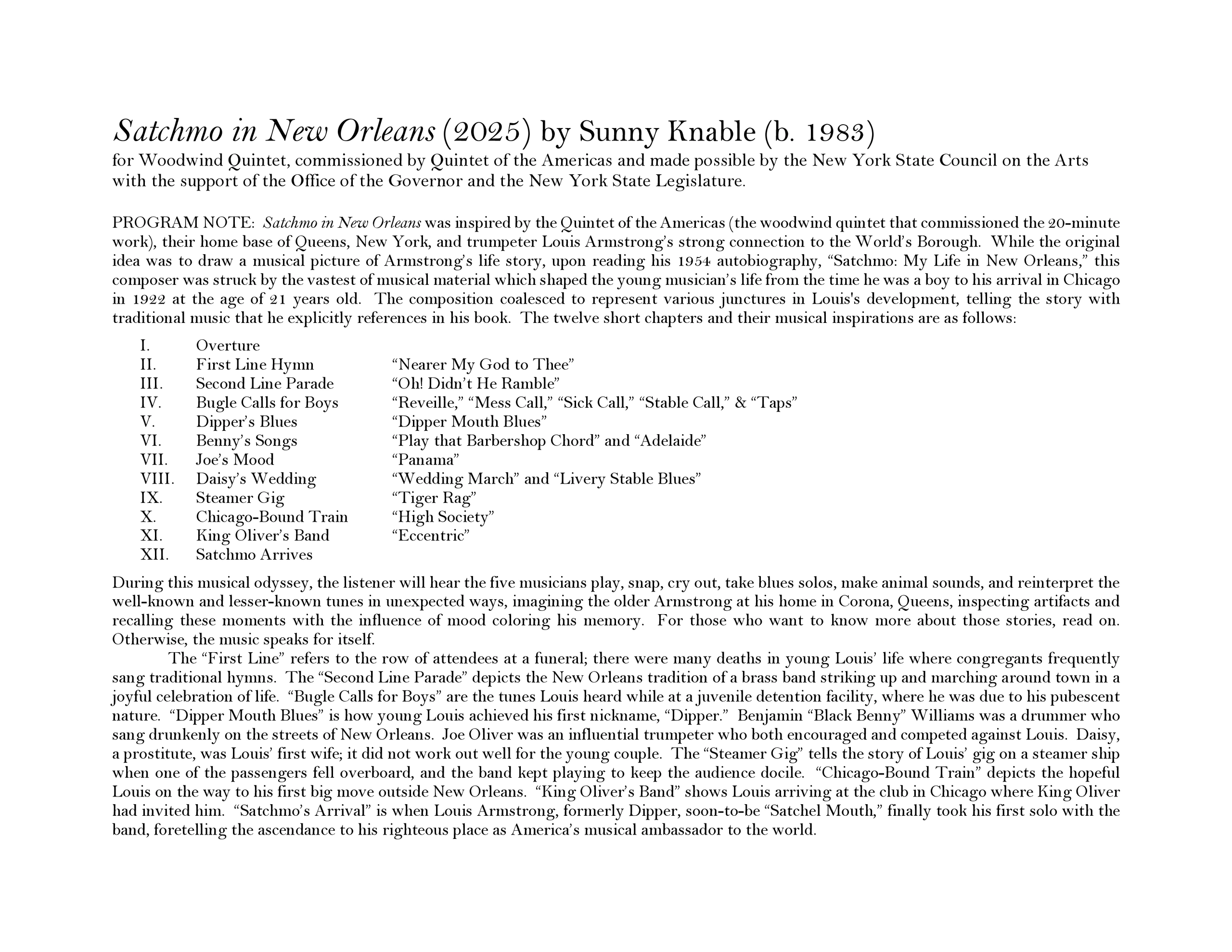
"Satchmo in New Orleans" was inspired by the Quintet of the Americas (the woodwind quintet that commissioned the 20-minute work), their home base of Queens, New York, and trumpeter Louis Armstrong’s strong connection to the World’s Borough. While the original idea was to draw a musical picture of Armstrong’s life story, upon reading his 1954 autobiography, “Satchmo: My Life in New Orleans,” this composer was struck by the vastest of musical material which shaped the young musician’s life from the time he was a boy to his arrival in Chicago in 1922 at the age of 21 years old. The composition coalesced to represent various junctures in Louis's development, telling the story with traditional music that he explicitly references in his book. The twelve short chapters and their musical inspirations are as follows: I. Overture II. First Line Hymn “Nearer My God to Thee” III. Second Line Parade “Oh! Didn’t He Ramble” IV. Bugle Calls for Boys “Reveille,” “Mess Call,” “Sick Call,” “Stable Call,” & “Taps” V. Dipper’s Blues “Dipper Mouth Blues” VI. Benny’s Songs: “Play that Barbershop Chord” and “Adelaide” VII. Joe’s Mood “Panama” VIII. Daisy’s Wedding “Wedding March” and “Livery Stable Blues” IX. Steamer Gig “Tiger Rag” X. Chicago-Bound Train “High Society” XI. King Oliver’s Band “Eccentric” XII. Satchmo Arrives During this musical odyssey, the listener will hear the five musicians play, snap, cry out, take blues solos, make animal sounds, and reinterpret the well-known and lesser-known tunes in unexpected ways, imagining the older Armstrong at his home in Corona, Queens, inspecting artifacts and recalling these moments with the influence of mood coloring his memory. For those who want to know more about those stories, read on. Otherwise, the music speaks for itself. The “First Line” refers to the row of attendees at a funeral; there were many deaths in young Louis’ life where congregants frequently sang traditional hymns. The “Second Line Parade” depicts the New Orleans tradition of a brass band striking up and marching around town in a joyful celebration of life. “Bugle Calls for Boys” are the tunes Louis heard while at a juvenile detention facility, where he was due to his pubescent nature. “Dipper Mouth Blues” is how young Louis achieved his first nickname, “Dipper.” Benjamin “Black Benny” Williams was a drummer who sang drunkenly on the streets of New Orleans. Joe Oliver was an influential trumpeter who both encouraged and competed against Louis. Daisy, a prostitute, was Louis’ first wife; it did not work out well for the young couple. The “Steamer Gig” tells the story of Louis’ gig on a steamer ship when one of the passengers fell overboard, and the band kept playing to keep the audience docile. “Chicago-Bound Train” depicts the hopeful Louis on the way to his first big move outside New Orleans. “King Oliver’s Band” shows Louis arriving at the club in Chicago, where King Oliver had invited him. “Satchmo’s Arrival” is when Louis Armstrong, formerly Dipper, soon-to-be “Satchel Mouth,” finally took his first solo with the band, foretelling the ascendance to his righteous place as America’s musical ambassador to the world.
- Performer Credits
- Quintet of the Americas
- Publisher
- Trouvère Music Publishing LLC