1 / 23
0:00/0:00
Solo
2009
Piano
Tape
- Program Notes
Accent Sequence
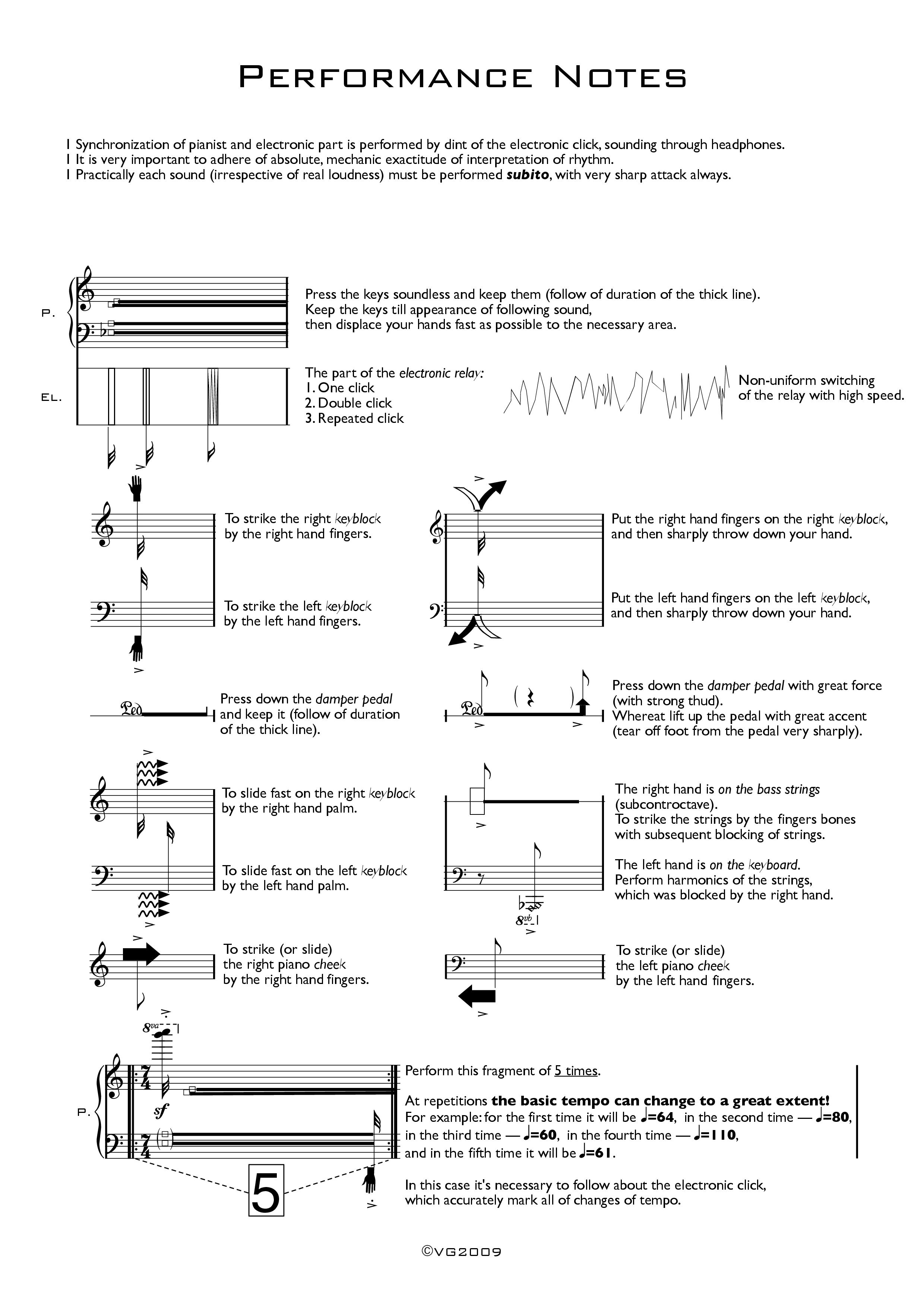
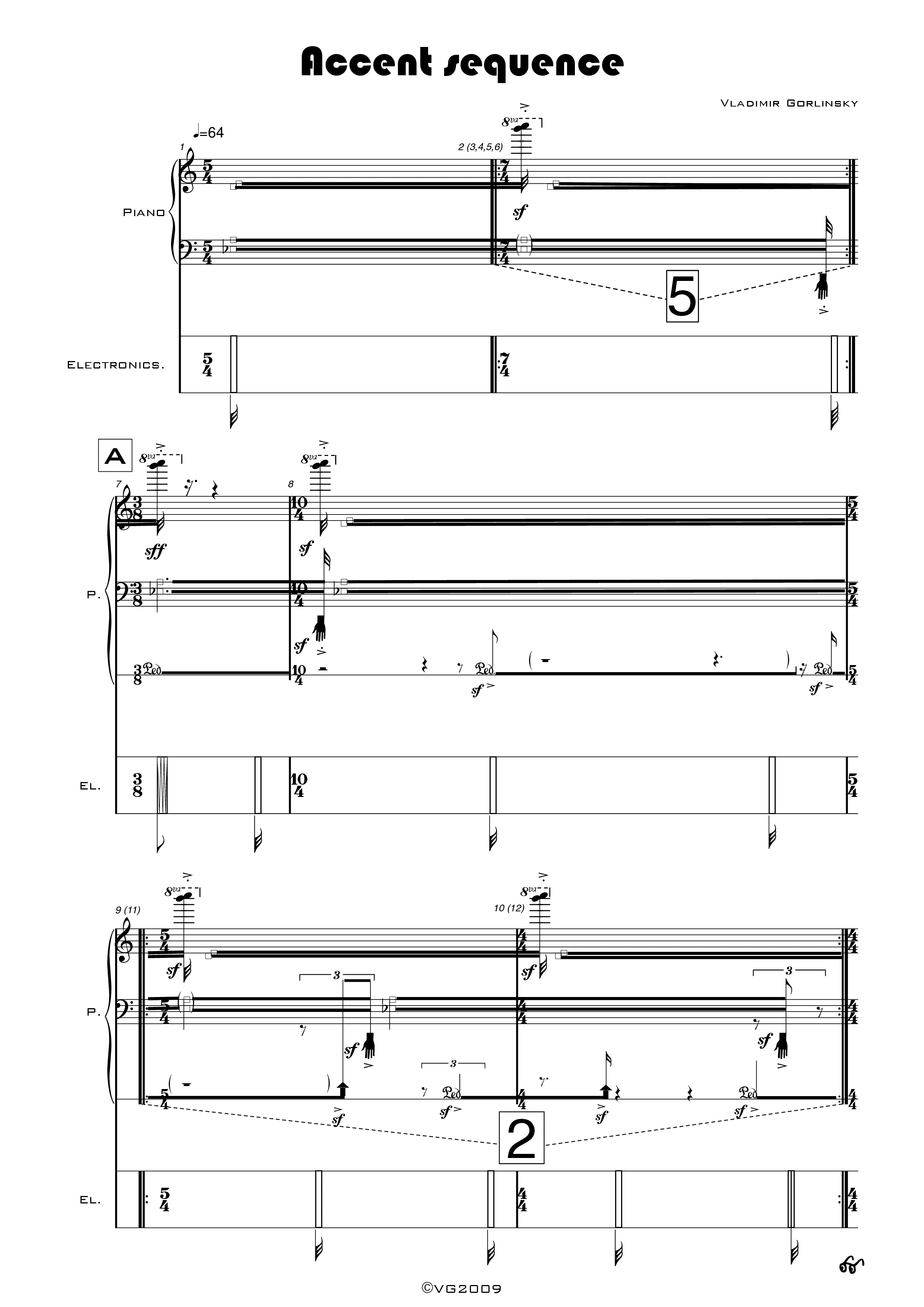
The composition Accent Sequence explores the idea of a biomechanism. The performer (pianist) and the apparatus (an electric relay placed on the piano strings) form a single integrated system. The score contains two parallel sequences: highly accentuated, percussive actions for the pianist, and opening/closing actions for the relay. The piece is structured so that the pianist’s gestures align rhythmically with the relay’s activity, creating a unified mechanism of interaction based on a predetermined sequence.
Here, the performer’s actions—executed strictly according to the score—are viewed as those of a human “mechanism” carrying out a program written in advance by the composer. Freedom of interpretation, especially rhythmic freedom, is not permitted. The live performer, as it were, competes in precision with a robotic mechanism. When both “performers” successfully execute their parts, their coordinated effort gives rise to an apocalyptic, passionately charged fandango — Accent Sequence.
The device on the piano strings is an electromechanical relay controlled by a microcircuit. Its distinctive feature lies in its extreme operational speed. In a sense, the mechanism resembles a piano hammer, but made of metal; yet its working speed far exceeds the pianist’s physical capability. The relay can easily produce 20–30 actions per second without losing clarity.
In the middle section of the piece, the listener’s perception is deliberately challenged. The performer strikes the note B (“si”) on the piano, and immediately afterward, an electronic tone of the same pitch is added, effectively “capturing” the piano’s sound. To the listener, it seems that the piano tone does not fade but instead becomes continuous—sounding “infinitely.” It appears to be the same note B as at the beginning, but this is an illusion: the electronic tone gradually, over four minutes, decreases in pitch. The listener cannot perceive such a slow change. At the end of the piece, the pianist strikes B again, revealing the difference—the electronic tone has by then significantly dropped in frequency.
- Recording Notes
Dmitry Batalov 2025
- Performer Credits
- Dmitry Batalov
- External Links