1 / 252
0:00/0:00
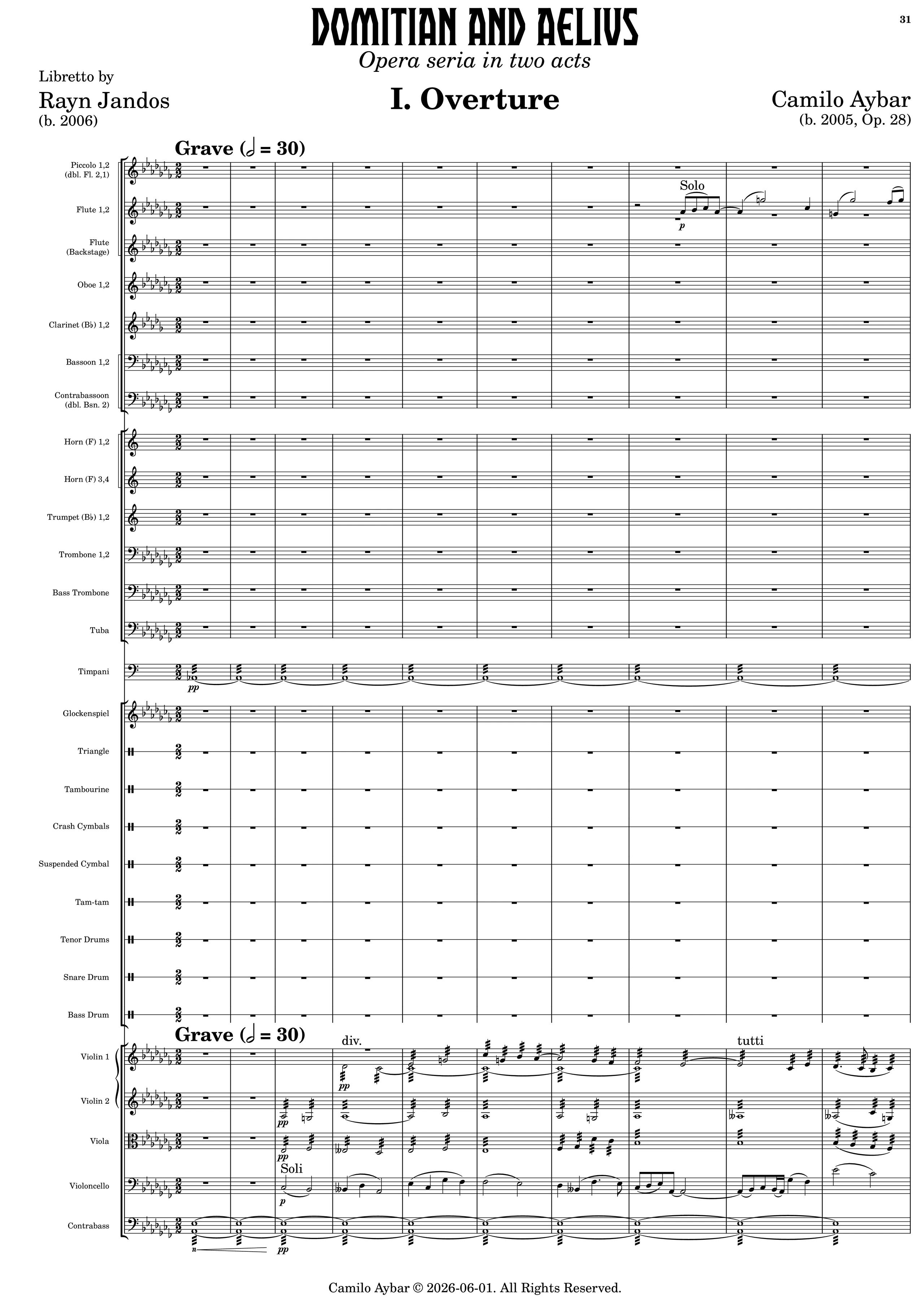
Camilo Aybar's most ambitious project to date. A massive Ancient Roman opera seria exploring themes of power dynamics in relationships, human greed, contradiction, desperation, and distrust (basically his compositional canon in a nutshell) with text written by his good friend Librettist-Baritone Rayn Jandos. Unique in its integration of neo-Baroque and neo-Romantic idioms combined with the use of microtones imitating Ancient Roman tuning systems, the libretto channels Jandos’ obsession for the Roman Empire. It follows lesser-known Emperor Domitian on his path of mental degradation, where after succumbing to love with his servant, Aelius, Domitian’s manipulative niece, Julia Flavia, commits several murders and atrocities in order to secure her power, exploiting this newfound tender side of Domitian.
Act I Summary:
The opera opens in the Forum Romanum, where a grand funeral
procession is held for Emperor Titus. His brother, Domitian, now
the new ruler, declares that there is no time to mourn and
orders the Senate to deify Titus by erecting a triumphal arch in
his honor.
Domitian then inspects the Praetorian Guard at their barracks,
asserting his authority and ensuring their loyalty. However,
when questioned by the Prefect, Casperius Aelianus, Domitian
sternly reminds him that he is not to be questioned as his
brother was.
At the Curia Julia, tensions rise among the Senators. Consul
Gaius Evander urges caution in dealing with the new emperor,
while Senator Agrippa voices concerns about Domitian’s disdain
for the Senate. Their fears are realized when Domitian arrives,
berating them as weak and issuing sweeping military reforms.
He commands them to begin construction of Titus’ Arch and
dismisses them contemptuously.
The scene shifts to the Imperial Palace, where the young servant
Aelius prepares Domitian’s bath. Despite his station, Aelius shows
remarkable confidence, engaging in witty repartee with the
emperor. Domitian, intrigued, confesses his loneliness and past
betrayals, including his wife’s infidelity. The moment escalates
into a passionate exchange, culminating in a kiss between the
emperor and Aelius. Though Aelius hesitates, he ultimately
reciprocates, leaving him in awe of what has transpired.
The following morning, Prefect Casperius Aelianus finds Aelius
asleep in the bath and scolds him before escorting him to the
Throne Room, where Domitian warmly greets Aelius. When the
Prefect protests Aelius’s informal tone, Domitian shocks
everyone by declaring that Aelius is more than a servant and
deserves equal respect. After the Prefect departs, Domitian sings
No. 10 – Aria: “Crowned in Iron”, revealing his internal struggle
between power and personal desire. He passionately embraces
Aelius once more, and they exit together, lost in the moment.
Meanwhile, Julia Flavia, Domitian’s niece, arrives at the Palace
Gates and brutally murders a Praetorian guardsman blocking
her path. Disgusted by what she sees inside the Throne Room,
she sings No. 11 – Aria: “The Wretch”, expressing her disdain for
Domitian’s perceived weakness and vowing to secure her
rightful place by forcing him to marry her.
Later, Domitian and Aelius sit together in the Imperial Box at
the Flavian Amphitheatre, where a grand Naumachia (mock
naval battle) takes place. The chorus sings No. 12 – “Naumachia
in the Flavian Amphitheatre”, celebrating the bloodshed while
questioning Domitian’s strength as a ruler.
That night, in Domitian’s bedroom, Aelius questions the
necessity of such violent spectacles. Domitian, initially dismissive,
softens and reaffirms his deepening feelings. He declares his wish
to marry Aelius, imagining a grand ceremony in Ostia.
Overwhelmed with emotion, Aelius reciprocates, leading into
No. 13 – Duet: “Vows in the Dark”, where they exchange vows of
love and devotion.
As their duet reaches its climax, they embrace in the dim
candlelight, sealing their fates together. The act ends with their
declaration of love, leaving the audience to wonder how long
such an unconventional union can last under the scrutiny of
Rome.