1 / 34
0:00/0:00
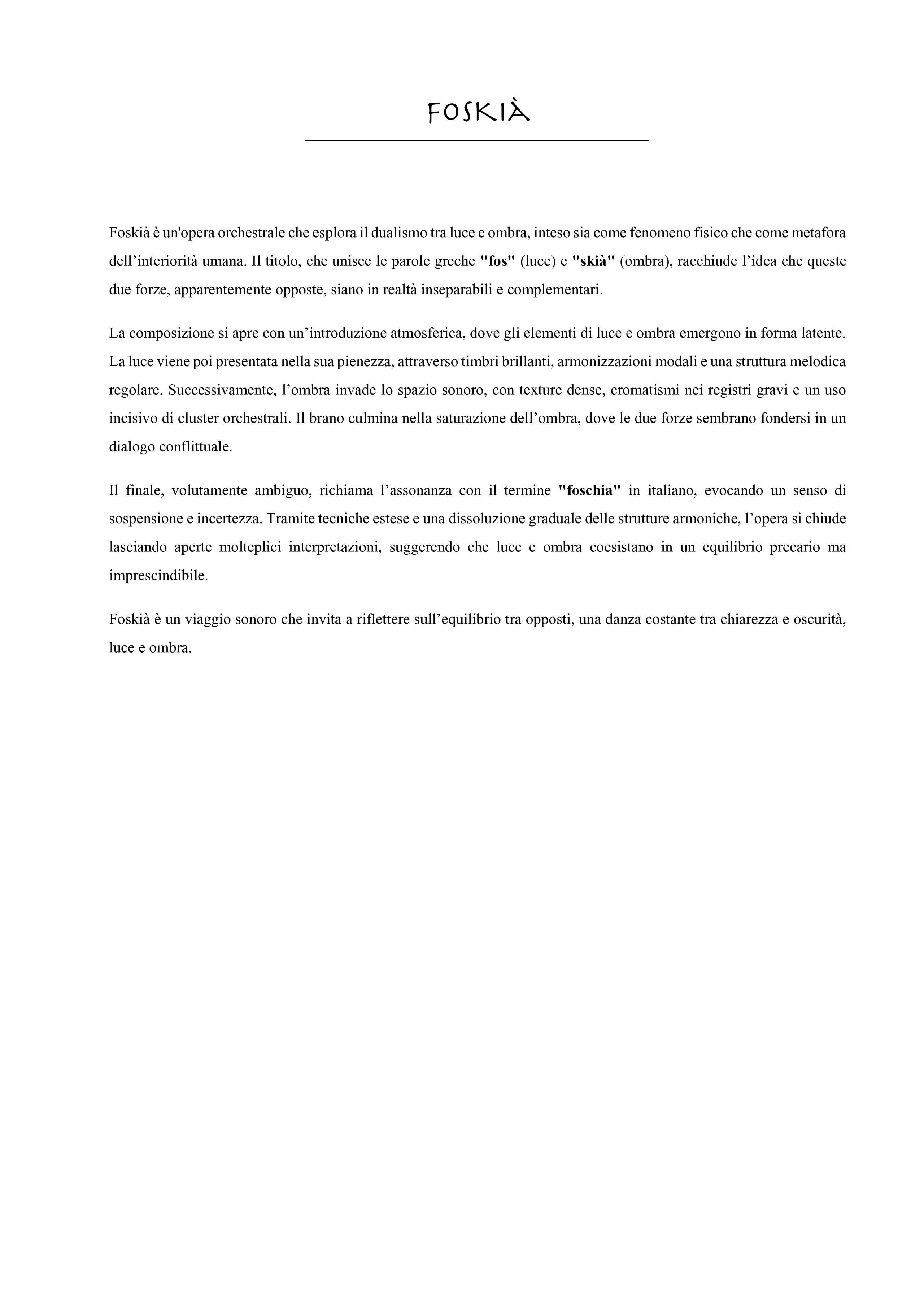
Foskià is an orchestral work that explores the dualism between light and shadow, understood both as a physical phenomenon and as a metaphor for human inner experience. The title, derived from the Greek words phōs (light) and skiá (shadow), reflects the idea that these two seemingly opposite forces are in fact inseparable and complementary.
The composition opens with an atmospheric introduction, where elements of light and shadow emerge in a latent form. Light is then fully revealed through bright timbres, modal harmonies, and a clear, structured melodic design. Gradually, shadow takes over the sonic space, characterized by dense textures, chromatic writing in the lower registers, and a powerful use of orchestral clusters. The work reaches a climax in the saturation of shadow, where the two forces merge into a tense and conflictual dialogue.
The ending, intentionally ambiguous, alludes to the Italian word foschia (“mist”), evoking a sense of suspension and uncertainty. Through extended techniques and a gradual dissolution of harmonic structures, the piece closes without resolution, leaving multiple interpretative possibilities and suggesting that light and shadow coexist in a fragile yet essential balance.
Foskià is a sonic journey that invites reflection on the equilibrium between opposites, a continuous interplay between clarity and darkness, light and shadow.
Performed by the Conservatorio "Alessandro Scarlatti" Orchestra at the Teatro Massimo in Palermo on February 2, 2025, as the opening concert of the 2025 season