MI-deez nuts lmao (2025)
Chloe Grove
162 views
- Program Notes
In the process of composing my piece for MIDI, entitled MI-deez nuts lmao, I took what I would term as a “patchwork” approach - stitching together a variety of different and contrasting sound types, phrase shapes, dynamics, etc. - while making extensive use of the numerous functionalities of the wheels and knobs of the keyboard that were available to me. This resulted in a piece that is both a deep and thorough exploration of timbre and musical technique, with particular emphasis on timbre and sonic atmosphere.
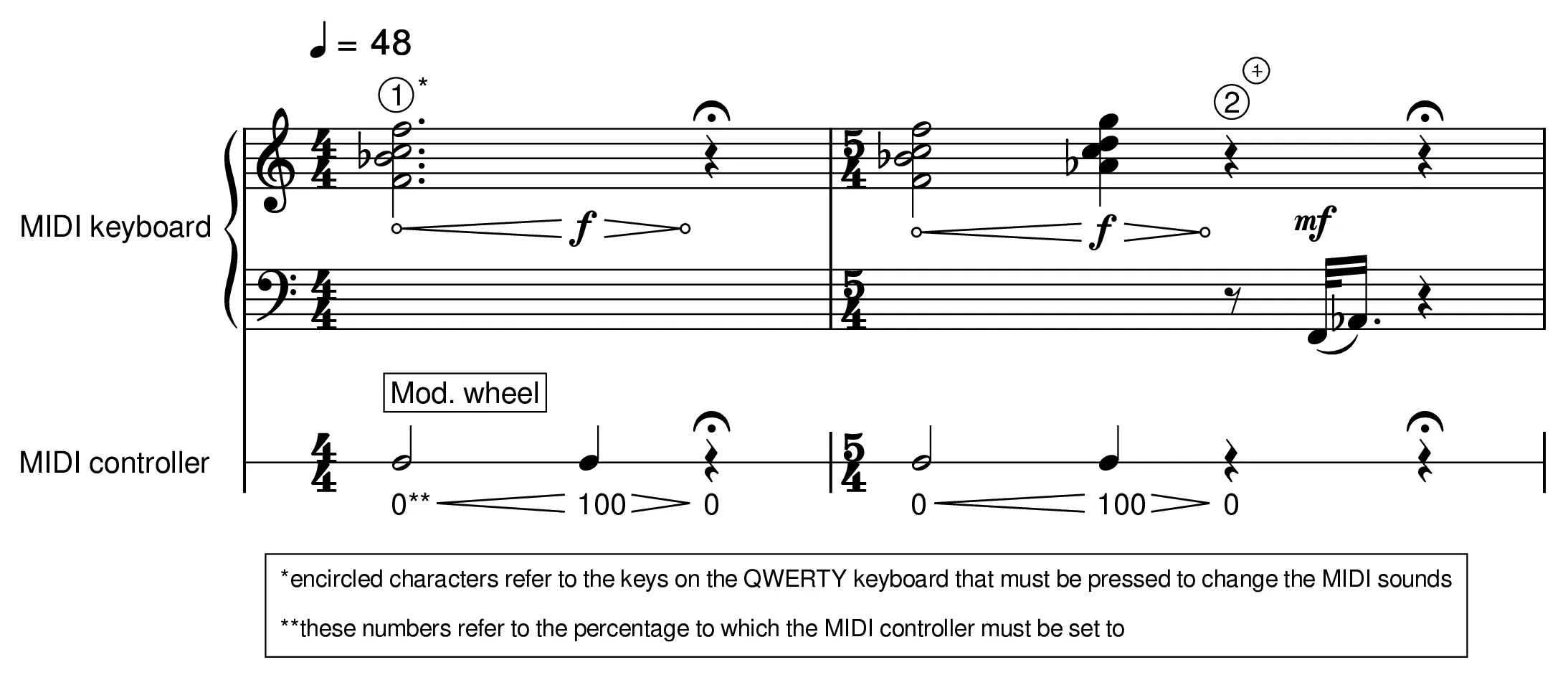
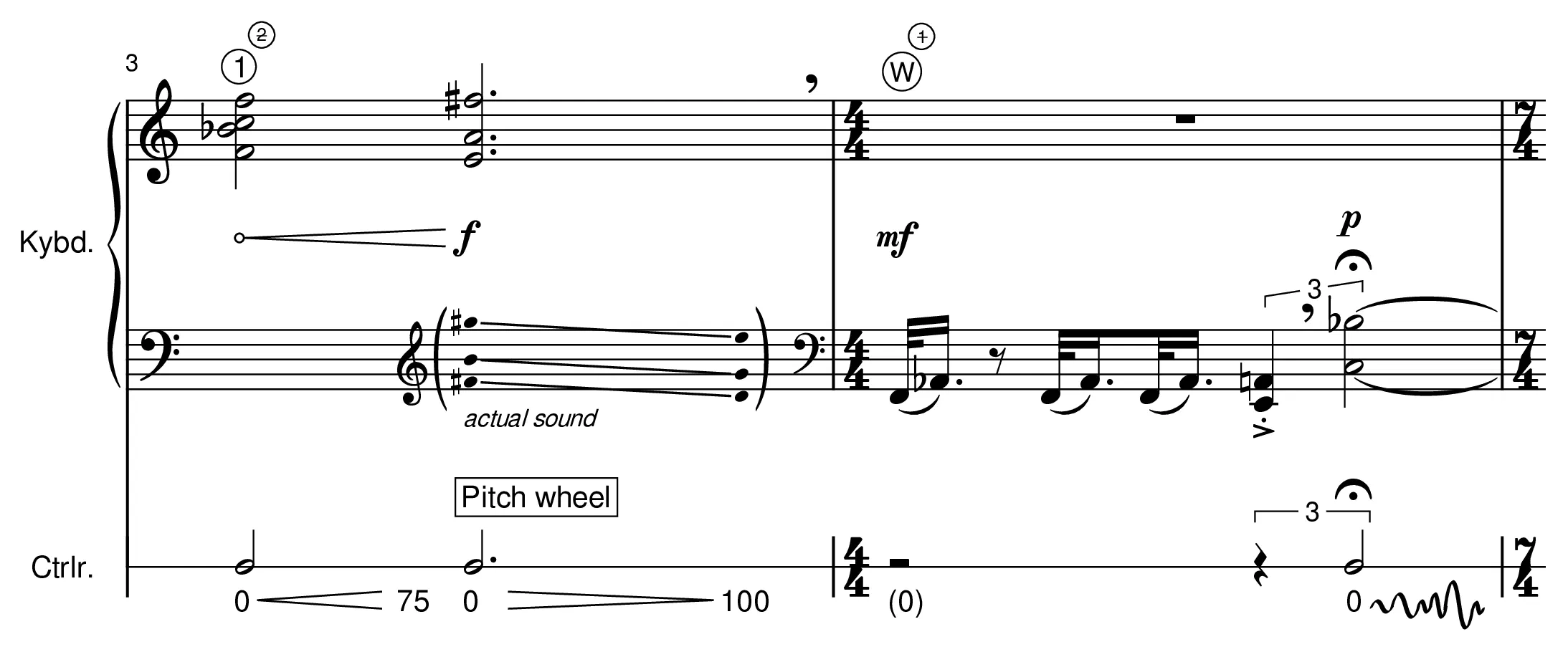
I began by creating an array of sounds that I intended to make sound as different to one another as I possibly could, thus allowing me an extensive palette to work with. This included making use of the Wavetable, which I then manipulated in a number of ways, such as through EQ and the application of numerous MIDI and audio effects. For some sounds, I made use of the Instrument Rack feature, which allowed me to group individual sounds together and assign different effects via the macro controls. I would then assign certain values to either QWERTY keys or, more often, the MIDI controls, i.e. the modulation wheel and the volume slider (denoted in the score as ‘Knob 1’). I ended up, in total, with ten separate sounds of vastly different timbral qualities, one of which I was able to set up to play semi-automatically through the P and X keys (delineating ‘play’ and ‘stop’ respectively).
My next step was to then structure the sounds in a cohesive way, so as to allow for as effective an exploration into the sounds as possible. This part of the overall compositional process took the greatest amount of time, as it jointly involved the writing of the score in tandem with the actual development and creation of each sound. I spent some time thinking about how I wanted each sound to fit in with or be pitted against one another whilst simultaneously maintaining a decisive balance of density and space, then notated each section in accordance. A great deal of time was also spent on thinking over the best possible way of expressing the desired effects from each sound in the sheet music, as any issues in communicating my intentions would run the risk of the wrong sort of effects being produced, so clarity in this was a major centre of attention for me. In particular, the trickiest parts pertained to the depiction of the MIDI controllers, i.e. the modulation wheel and volume slider, and how I would most effectively represent changes in position and transitions between each of the controls. This led to me putting the MIDI controls on a separate stave in the score, which I felt most clearly conveyed their role in the piece (as a means of expanding the sonic potential available) while making things as easy to understand as I felt was possible.
The final part of the process was the recording of the piece. This section was ultimately the trickiest for me, since I had written the piece to ideally be performed by someone aside from myself, so for me to be able to perform this in the way that I had intended it to sound took a great amount of patience and trial and error. In particular, I found that keeping the material I had written as cohesive and smooth as possible, mainly in the transitions between sounds, was the most tricky thing to achieve, since the knob twists and button presses were more time-consuming to get right than I had previously anticipated. However, with persistence and practice, I was able to get each section to a standard I felt happy with. I made use of some “extended techniques”, such as clusters and palm glissandi, and I also took care to vary the techniques, articulation, phrase lengths and tempi, thereby increasing the overall contrast in sound and expanding the piece’s sonic palette.
- Performer Credits
- Chloe Grove